


Growth Navigate Funding: A Strategic Action Framework For Business Growth
Asking for expansion capital isn’t just about putting together a polished pitch deck and hoping investors buy into your growth numbers.
Taking on outside money before fixing your core business operations usually leads to trouble. Companies get stuck with high interest rates, suffer unexpected cash shortages, or hand over way too much control to early investors.
Growth Navigate Funding fixes that by switching the focus to capital readiness. Before you sit down with lenders or venture capital firms, you audit your books, test your margins, and figure out the exact deal terms your business can actually support.
Whether you run a scaling tech company, an e-commerce store stocking up for the holidays, or an established business moving into a new region, getting your internal metrics straight is what keeps you from risking the whole operation.
What Growth Navigate Funding Actually Means

This framework is about getting your internal finances clean before taking on external cash.
Fundraising shouldn’t be used to paper over bad monthly cash flow. Capital works best as fuel, added only when the business engine is already turning a steady profit on its own.
Taking the traditional route usually means panicking during a cash drought, rushing through pitches, and accepting bad terms.
The Growth Navigate approach uses a clear financial audit to prove your unit economics, giving you actual leverage when negotiating terms.
The Biggest Misconception About Growth Capital
The biggest misconception about growth capital is that it can fix a struggling business. In reality, funding rarely solves operational problems. It typically amplifies what's already there. In fact, strong businesses use capital to grow faster, while weak businesses often use it to accelerate losses, cash burn, and financial risk.
One of the most common assumptions among business owners is that funding solves financial problems.
In reality, capital rarely fixes an unhealthy business. It usually magnifies whatever already exists.
If your company has stable margins, disciplined spending, and predictable customer demand, additional funding can accelerate expansion.
You may hire faster, enter new markets, increase inventory, or invest in equipment with confidence.
The opposite is equally true.
Businesses with inconsistent profitability often believe that raising more money will create stability.
Instead, they simply increase the amount of capital flowing through an inefficient operation. Cash disappears faster, repayment obligations become heavier, and investor expectations grow more demanding.
We’ve seen founders become focused on securing funding while overlooking the operational issues that actually needed attention first.
Delayed invoicing, weak pricing strategies, poor inventory controls, and customer concentration risk frequently create larger problems than the absence of outside capital.
Growth Navigate Funding encourages businesses to reverse the sequence. Strengthen operations first. You can always raise capital after that.
Funding should accelerate momentum, not create it.
Why Raising Capital Fails So Often?
When founders pitch unprepared, they usually run into three main obstacles:
First is the risk penalty. If your books look messy, banks charge higher interest rates, demand extra collateral, or insist on personal guarantees to cover their risk.
Second is equity dilution. Investors demand bigger ownership cuts when you cannot show solid data for your Customer Acquisition Cost or Customer Lifetime Value.
Third is accelerated burn. Adding capital to a business with weak margins just speeds up how fast you run through cash.
Five Signs Your Business Isn’t Ready For Growth Funding
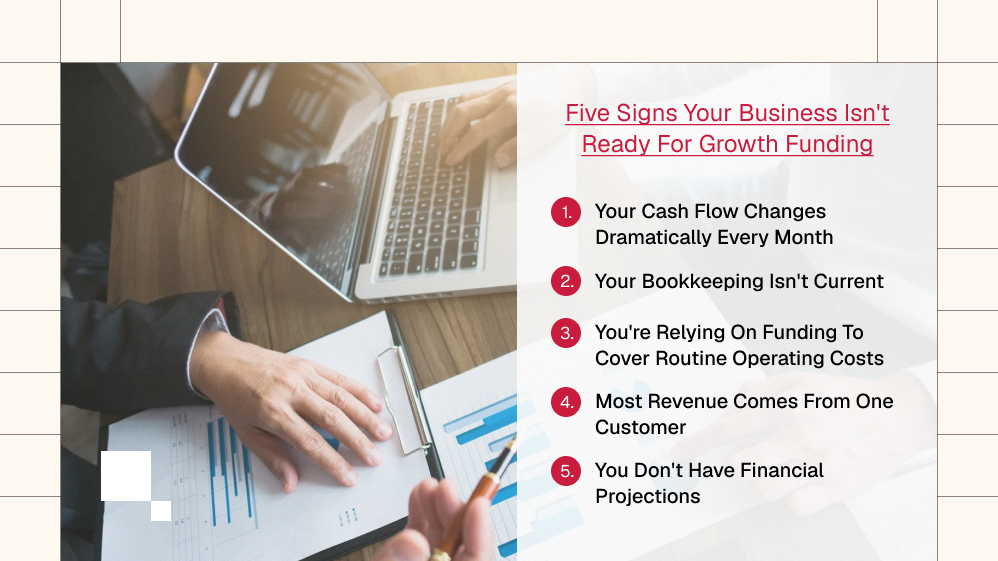
Many businesses begin speaking with lenders months before they should. Before pursuing outside capital, ask yourself whether any of these warning signs apply.
Your Cash Flow Changes Dramatically Every Month
Revenue fluctuations make repayment planning difficult. If monthly cash inflows vary significantly without a clear explanation, lenders may question your ability to service debt consistently.
Your Bookkeeping Isn’t Current
Financial statements should accurately reflect the business. Missing reconciliations, outdated reports, or unclear expense categories immediately reduce credibility during due diligence.
You’re Relying On Funding To Cover Routine Operating Costs
Borrowing money simply to pay salaries, rent, or existing suppliers usually indicates an underlying cash flow issue rather than a temporary financing need.
Most Revenue Comes From One Customer
Customer concentration increases risk. Losing a single major client can significantly affect the business’s ability to meet repayment obligations.
You Don’t Have Financial Projections
Experienced lenders and investors expect businesses to understand how additional capital will generate measurable returns. Forecasts don’t need to predict the future perfectly, but they should demonstrate thoughtful planning.
Identifying these issues before fundraising often produces better financing options than rushing into discussions while weaknesses remain unresolved.
The Interactive Capital Readiness Calculator
Before reaching out to lenders or pitching investors, run your actual figures through key operational metrics.
Use this tool to check your Growth Navigate Readiness Score and spot red flags before external underwriters look at your books.
Growth Navigate Capital Readiness Calculator
Adjust your business metrics below to calculate your Readiness Score and evaluate your capital readiness before speaking to underwriters.
Analysis & Recommendations
For other growth navigate startup tools, check out Emblemwealth.com.
How To Interpret Your Capital Readiness Score
A calculator is only useful if you understand what the results actually mean. As a general guide:
80–100 points
Your business appears financially prepared to begin conversations with banks or investors. Continue validating assumptions through professional financial review.
60–79 points
Your fundamentals may support funding, but improvements in forecasting, reporting, or profitability could significantly strengthen your negotiating position.
40–59 points
Several operational risks deserve attention before pursuing external capital. Improving financial controls now may result in better financing terms later.
Below 40
Growth funding may introduce more pressure than opportunity. Focus first on strengthening cash flow, margins, and financial reporting before seeking outside capital.
Remember that no calculator can replace detailed financial advice. Use the score as a starting point rather than a final decision.
The Core Pillars Of Capital Readiness
To safely handle expansion debt or equity, your company needs four solid pillars in place.
1. Financial Transparency And Clean Books:
Underwriters scrutinize balance sheets for hidden debts and irregular expenses.
Separate your personal accounts from business accounts completely, removing personal car leases or non-essential perks from your bookkeeping.
Recalculate EBITDA by adding back one-time expenses so your true operating profit shows through, and move from cash-basis to accrual accounting so deferred revenue lines up correctly with cash flow.
2. Verified Unit Economics:
Every customer you bring in needs to contribute net profit after paying overhead. Track your Customer Acquisition Cost by dividing total marketing spend by the number of new customers added.
Match that against Customer Lifetime Value, factoring in gross margins and average retention length. A healthy LTV-to-CAC ratio sits at 3 to 1 or higher. Drop below 2 to 1 and paid marketing campaigns start eating your profits.
3. Matching Capital To The Right Purpose:
Pick a funding type that aligns directly with what you are spending money on. SBA and bank loans suit long-term equipment purchases or real estate, offering lower rates with zero equity loss.
Revenue-based financing fits seasonal inventory orders or proven ad campaigns, trading a cut of sales until a set cap is reached without taking ownership.
Venture debt works well for VC-backed startups extending runway between rounds with minimal equity warrants.
Growth equity and VC fit massive market expansions or heavy R&D. But expect to give up 15 to 40 per cent of your company.
4. Calculating Exact Capital Needs:
Avoid asking for round numbers like two hundred thousand dollars without context.
Instead, calculate your need based on runway and operational milestones. But how to do that?
Multiply your net monthly cash burn by the number of months needed. Then add one-time expansion expenses.
For example, an 8 lakh monthly burn across 18 months plus 60 lakh in upfront equipment adds up to 2.04 crore in total required capital.
Questions Every Lender Or Investor Will Ask
Whether you’re meeting a commercial lender, an angel investor, or a private equity firm, the underlying questions remain remarkably consistent.
Expect to answer questions such as:
- Why do you need this specific amount of capital?
- What measurable business objective will the funding achieve?
- How will additional revenue exceed the cost of capital?
- What happens if sales decline during repayment?
- What collateral supports the financing?
- How dependent is the company on the founder?
- Are tax obligations current?
- How diversified is the customer base?
- What assumptions support your financial forecasts?
Preparing clear answers before negotiations begin improves credibility and demonstrates disciplined financial management.
How Different Funding Models Compare

Debt financing lets you keep full ownership while paying fixed monthly amounts. Equity financing avoids monthly debt payments entirely. But costs you a permanent percentage of your future exits and dividends.
On the other hand, the hybrid models like revenue-based financing scale your repayments up or down depending on monthly sales performance.
Bank loans offer the lowest annual rates. But they require heavy documentation, solid credit scores above 680, and up to three months of review time.
Revenue-based options fund within days with zero equity loss, though they eat into daily operating cash flow until paid off.
Venture debt offers a middle ground for venture-backed startups needing extra runway without setting a new company valuation.
Equity investment brings strategic guidance and industry networks, but forces you toward a major sale or IPO within five to seven years.
Choosing the Right Funding Model Based on Business Stage
| Business Stage | Common Objective | Usually Suitable Funding |
| Startup | Product development | Angel investment, venture capital |
| Early revenue | Customer acquisition | Revenue-based financing |
| Growing business | Expansion | Bank loan, SBA loan |
| Mature company | Acquisition | Private debt, growth equity |
| Established enterprise | Large expansion | Private equity, syndicated loans |
Then explain why each stage has different funding priorities.
Step-By-Step Implementation Timeline
Getting ready for capital usually takes three to six months of work before signing any paperwork.
In months one and two, clean up your financial records. Reconcile bank accounts, settle back tax obligations, and transition to accrual accounting standards.
During month two, stress test your unit margins. Run numbers to see how cash flow responds if sales drop 15 per cent or supply costs jump 10 per cent.
By month three, model your debt service coverage ratio against potential equity dilution so you know your exact limits before starting conversations.
From months three to six, open conversations with potential funding partners. Present an organized data room and use competing offers to push for lower rates or fewer restrictive covenants.
Common Funding Mistakes That Can Reduce Business Value
- Raising money too early
- Raising more than necessary
- Choosing investors only because they offer the highest valuation
- Ignoring restrictive loan covenants
- Depending entirely on debt
- Assuming future growth will solve repayment
- Overlooking tax consequences
- Forgetting exit planning
“The best financing decisions improve business value without creating unnecessary financial pressure.”
Fine Print Details That Can Harm Your Business
Always read deal terms carefully. Watch out for warrant coverage in debt agreements, which lets lenders buy company shares later and dilutes your ownership on what was supposed to be a standard loan.
Be cautious with liquidation preferences in equity deals. To clarify, a 1x or 2x participating preference means investors take their full check back before anyone else gets paid during a sale.
Watch for broad Material Adverse Change clauses that allow lenders to recall loans if your market conditions shift, and push hard to limit or cap personal guarantees tied to your family assets.
Read Also: How to Build a Bootstrapped Startup Financial Model That Actually Saves Your Business
A Due Diligence Checklist Before Signing Any Funding Agreement
✓ Interest rate
✓ APR
✓ Fees
✓ Collateral
✓ Personal guarantees
✓ Restrictive covenants
✓ Default clauses
✓ Equity dilution
✓ Board seats
✓ Information rights
✓ Exit clauses
✓ Prepayment penalties
“If you cannot clearly explain every major clause in the agreement, seek independent legal and financial advice before signing.”
Case Studies From The Field
Here are the results from multiple field data points we collected while writing this article on Growth Navigate Funding. We did 1:1 sample studies with entrepreneurs, business enthusiasts, and even investors. The data we found will shock you too:
Take the e-commerce retailer pulling in $120K a month who needed $200K to stock up for the holidays. The obvious move would’ve been giving up 25% equity to an angel investor.
Instead, they went to a revenue-based financing firm, showed them a 3.8x return on ad spend, and got the advance without giving away a single share.
Seven months later, it was paid off. They still own every bit of the company.
Then there’s a B2B SaaS company sitting at $40K MRR with unit economics most founders would kill for: 4.5 to 1. That kind of ratio gives you leverage.
Instead of the standard 25% haircut on equity, they walked into growth equity talks and walked out having given up just 12%.
A manufacturing firm needed $1.2 million in new machinery. Rather than raise equity for it, they stacked an SBA 504 loan on top of their own cash reserves.
Production jumped 60%. Ownership stayed exactly where it was.
And a consulting firm stuck with a client on 90-day payment terms for a $300K contract didn’t want to take on long-term debt just to make payroll.
So they secured a revolving line of credit against their receivables instead. To simplify, they faced a short-term problem and a short-term (and self-liquidating) solution.
Please Note: The names and whereabouts of the individuals/agencies/entities have not been disclosed, in their best interests.
Looking Beyond Funding: Protecting Long-Term Wealth
Here’s something a lot of founders miss: the goal of raising money isn’t just to raise money. It’s supposed to build wealth that outlasts the funding round itself.
Most owners spend all their energy chasing the check and almost none thinking about what the deal actually costs them once the ink is dry.
But what about the terms you agree to? For instance, how much equity you give up? Or what dividend rights look like, how it affects succession or an eventual sale. In real life, those things follow you for years. Sometimes decades.
Consider this: holding onto an extra 10% of a company that’s growing fast can, in the long run, be worth more than taking a flashier valuation and handing over a bigger slice to get it.
To clarify, the same logic applies to how flexible your financing leaves you operationally. Simply put, that flexibility is often what makes a future acquisition offer, or a strategic partnership, actually possible.
The founders who do this well don’t treat financing as a one-off event. They check in on it and care about certain parameters:
- Does this still line up with where I want to end up financially? They loop it into the same conversation as their estate plan, their tax strategy, their retirement goals
- How they’re protecting what they’ve already built. Because growth that happens today only means something if it’s still there, in some form, years from now.
Do it that way, and it’s not just the business that ends up better off. It’s the person who built it.
Founder Wealth Considerations
Your company is likely your largest financial asset. That means corporate deal terms like growth navigate funding directly affect your personal estate, tax obligations, and long-term net worth.
At Emblem Wealth, we help business owners structure corporate moves alongside personal wealth goals.
That means setting up proper entity holding structures to insulate personal property from business liability, timing interest deductions and share sales to reduce tax exposure, and designing capital moves today.
As a result, your ultimate payout stays protected when you eventually exit.


Must Read

Is Bankruptcy Right for You? Questions to Ask Before Filing in Georgia

How to Build a Modern Business Protection Strategy

Popular Street Bikes for Everyday Commuting

Head Of Growth Marketing Responsibilities: A Beginner’s Guide To The Role

How To Build A Growth Marketing Strategy That Actually Works
Most Popular

A Guide For Deductibles and Premiums in Accident Insurance
Financial Survival Tips for Entrepreneurs in Debt
Toronto Car Insurance vs. Other Cities: Why Are Rates So High?

The Future of MENA Businesses: Why You Need Both Management & Accounting Software


Leave A Reply