


How To Build A Growth Marketing Strategy That Actually Works

Many small businesses have tried growth marketing tactics. But the bigger question is: where do most of them go wrong?
Usually, the growth marketing tactics they know are an email here or a referral push there, without ever tying them together.
That’s the gap a real growth marketing strategy fills. It’s not one clever trick. In reality, it’s a plan that tells you what to test, in what order, and how to know when something’s actually working versus just feeling busy.
What Makes A Strategy Different From A Tactic
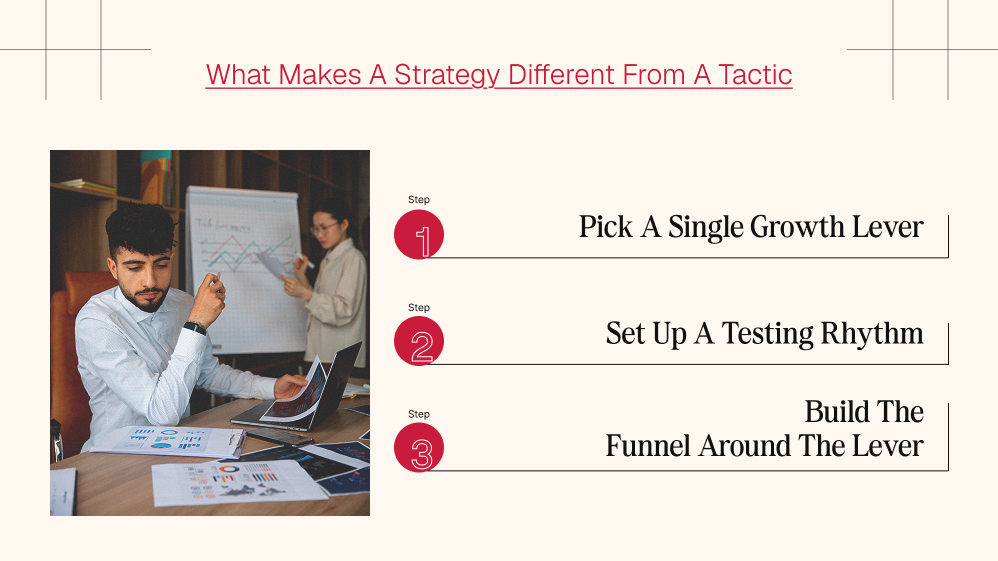
A tactic is a single move. For instance, you send an email. Or run a promo. A third: post more often. None of that is bad, but none of it adds up to much on its own either.
A growth marketing strategy connects those moves into a sequence. It sets a goal first. For instance, more repeat customers.
Then it works backward to figure out which tactics actually serve that goal and which ones are just noise. If you skip this step, you end up busy but not really growing. I’ve seen it happen more times than I can count.
Step One: Pick A Single Growth Lever
Most beginners try to fix everything at once. New customers, better retention, bigger average order size, all in the same month. It rarely works.
Solid growth strategies usually start with one lever. Maybe it’s acquisition. In other words, getting more people in the door. Again, maybe it’s retention. That’s keeping the customers you already have around longer.
Pick whichever one has the biggest gap between where you are and where you could reasonably be. And build the first few months of your strategy around closing that gap.
Here’s why this matters more than people think: retention math is brutal in the other direction. A well-known rule from Bain & Company found that boosting retention by just 5% can lift profits anywhere from 25% to 95%, depending on the industry.
That’s not a typo. Small retention gains do outsized work, which is exactly why a lot of growth marketing strategy work quietly shifts toward existing customers after the first wave of acquisition tests.
Step Two: Set Up A Testing Rhythm
Once you know your lever, the next piece of growth marketing strategies is deciding how you’ll test ideas against it.
This is where a lot of businesses get stuck. Not because testing is hard, but because nobody sets up a rhythm for it.
Industry data on A/B testing paints a useful picture here. Across large testing datasets, only around one in five tests produces a statistically significant winner. And the median lift on those winners tends to land somewhere between 6% and 8%.
That sounds unimpressive until you stack it. Five modest wins compounding over a year can add up to a 20% to 30% improvement on the thing you’re testing. That too, without ever needing a single dramatic breakthrough.
That’s the real lesson for a beginner-friendly growth marketing strategy. The rule is simple: don’t wait for the home run. Build a cadence where you’re always running something small, and let the wins pile up.
What You Actually Need To Track
You don’t need a fancy dashboard to run a growth marketing strategy. You need three or four numbers, tracked consistently, in one place.
Most beginners start with these:
- visitors or leads at the top of the funnel
- conversion rate at the point people take your desired action
- average order or deal size
- repeat rate over a set window, like 90 days.
A simple spreadsheet works fine for the first six months. Add software later, once manual tracking genuinely becomes a bottleneck, not before. And definitely not because a tool looked impressive in a demo.
One thing is worth flagging here: track your baseline before you run a single test. Again, if you skip this step, every result you get afterward is basically a guess dressed up as data.
Growth Marketing Strategy VS. Random Tactics
| Element | Random Tactics | Growth Marketing Strategy |
| Starting point | Whatever seems trendy | One clear metric or lever |
| Testing | Occasional, unstructured | Ongoing, on a set rhythm |
| Measurement | Vague, “it felt like it worked” | Tracked against a baseline |
| Budget | Reactive spending | Shifts toward what’s proven |
| Outcome | Short bursts of activity | Compounding, steady growth |
Look at that table for a second. The difference isn’t effort. Plenty of businesses running random tactics work just as hard as ones with a real strategy. The difference is direction.
Step Three: Build The Funnel Around The Lever
A growth marketing strategy needs a shape, and usually that shape is a funnel. Awareness leads to consideration, consideration leads to a first purchase, and a first purchase leads, hopefully, to a second one.
Most beginners over-invest at the top. More ads, more reach, more impressions. But the data tends to point elsewhere. Companies with structured conversion rate optimization programs report average returns around 223% on that testing investment.
It means they test and refine what happens after someone lands on their site, not just how many people show up. That’s a strong argument for spending time fixing what you already have before pouring more money into getting new visitors.
A practical way to apply this: map your funnel on paper, mark where people drop off the most, and put your growth marketing strategy’s next test right at that point. Not at the top. But just at the leak.
A Practical Example
A small home goods shop wanted to grow. Instead of jumping straight to paid ads, the owner mapped the funnel first. It turns out plenty of people were adding items to their cart and never checking out. You can surely call it a classic leak.
However, you could fix it with a small step: a one-line reminder email sent four hours after an abandoned cart, plus a modest, time-limited discount. Within a month, roughly 9% of abandoned carts converted that hadn’t before.
No new traffic. Most importantly, no bigger ad spend. Just a growth marketing strategy that pointed at the actual weak spot instead of guessing.
Three months later, that same shop layered on a second test. Nothing much: a short quiz on the homepage to route new visitors to relevant products faster.
As a result, the conversion from new visitors climbed a further 4 percentage points. Now to sum up, neither change was flashy on its own. Together, they reshaped the whole funnel.
Budgeting For A Growth Marketing Strategy
Money questions come up fast once testing starts producing results. A reasonable rule for many small businesses is to keep 70% to 80% of the marketing budget on whatever channel is currently proven, and set aside the rest for marketing strategy innovation.
Meanwhile, that split shifts over time. Simply put, a channel that’s winning today might not be winning in six months.
In the same vein, a growth marketing strategy has to stay flexible enough to notice that shift and move money accordingly. Rather than sticking with last year’s plan out of habit.
Common Ways a Growth Marketing Strategy Falls Apart
- No baseline. If you don’t know your current numbers, you can’t tell whether a test actually helped or if you’re just imagining progress.
- Testing everything at once. Change five things simultaneously, and you’ll never know which one moved the number.
- Switching levers too soon. Jumping from acquisition to retention to referrals every few weeks means nothing gets enough time to show real results.
- Ignoring small wins. A 6% lift doesn’t feel exciting, but stacked wins are how most real growth marketing strategy work actually plays out quietly, not dramatically.
How to Structure Your First 90 Days
If you’re starting from scratch, here’s a simple way to sequence it:
- Weeks 1-2: pick your lever and record your current baseline numbers.
- Weeks 3 – 6: run your first two tests, one at a time.
- Weeks 7 – 10: review results, keep what worked, and drop what didn’t.
- Weeks 11 – 13: layer in a second lever, now that the first one has some traction.
That’s roughly it. A growth marketing strategy doesn’t need to be more complicated than that to start producing real results.
Quick Answers To Common Questions (FAQs)
Do I need a big team to run a growth marketing strategy?
No. Most of what’s described here can be run by one person with a spreadsheet, a bit of discipline, and maybe an hour a week set aside for review.
How do I know which lever to pick first?
Look at where your numbers are weakest relative to industry norms. If retention is far below what similar businesses see, start there. If you barely have any repeat traffic to retain, acquisition probably comes first.
What if a test fails?
It’s not really a failure. I would call it an important source to gather information. Most tests don’t win. However, in reality, that’s normal. In fact, it’s a common part of how any solid growth marketing strategy is supposed to work.
What Marketers Cannot Skip
A growth marketing strategy isn’t about finding one perfect idea and riding it forever. It’s a system. So, pick a lever, test consistently, keep what works, and let small wins compound into something bigger than any single tactic could deliver on its own.
Start with one metric, run one test, and build from there. That patient, structured approach is what separates a real growth marketing strategy from a pile of tactics that never quite add up.
Additional Reading:


Must Read

Is Bankruptcy Right for You? Questions to Ask Before Filing in Georgia

How to Build a Modern Business Protection Strategy

Popular Street Bikes for Everyday Commuting

Head Of Growth Marketing Responsibilities: A Beginner’s Guide To The Role

Growth Marketing For Beginners: A Simple Way To Grow Your Small Business
Most Popular

A Guide For Deductibles and Premiums in Accident Insurance
Financial Survival Tips for Entrepreneurs in Debt
Toronto Car Insurance vs. Other Cities: Why Are Rates So High?

The Future of MENA Businesses: Why You Need Both Management & Accounting Software


Leave A Reply