


How To Increase Your Guest Posting ROI: A Practical Guide For Founders In 2026

When a fellow founder asked me last year whether she should spend $800 on a guest post on a well-known entrepreneurship platform, I didn’t give her a quick yes-or-no. I told her: ‘That depends on what you’re actually trying to buy with that $800.’
However, in reality, how much guest posting ROI you can generate is hinged on one question: What are you actually buying? How good is the guest post?
That brings us to consider how much guest-posting ROI you can generate in today’s content and SEO landscape. Let us explore how to calculate it in plain language, what it costs, and when it pays off.
At the same time, we must also check out where guest posting fails to deliver ROI. Such insights will help us make smarter investment decisions.
What Is Guest Posting ROI And Why Most People Measure It Wrong?

Guest posting ROI is the return (financial or otherwise) you get from writing and publishing articles on external websites. But here’s where most founders go wrong.
To clarify, they measure guest posting like a paid ad campaign, expecting clicks and conversions within the week. However, that’s the wrong lens.
Guest posting is a compounding investment, not a pay-per-click channel. In other words, you can generate ROI through guest posts. However, the guest posts should offer:
- Backlinks that improve your website’s search engine rankings over time
- Brand authority, when your name appears in respected publications
- Referral traffic from readers who click through to your site
- Lead generation from readers who connect with your perspective
- Relationship capital with editors, journalists, and influencers
The Three Layers Of Guest Posting ROI
| ROI Layer | What It Means | Timeline to See Results |
| SEO ROI | Domain authority lift, keyword rankings, organic traffic | 3–12 months |
| Brand ROI | Trust, credibility, share of voice in your niche | 6–18 months |
| Revenue ROI | Leads, demos, sales attributable to guest content | 6–24 months |
Most people only track the third layer. However they don’t continue guest posting after the second month. Adobe all, what they don’t understand that results follow the due course.
"Guest posting is one of the highest-leverage content investments you can make. But only if you're patient enough to let the compounding work."

• Neil Patel, Co-Founder of NP Digital, NeilPatel.com
 What You Should Do Right Now For better Guest Posting ROI

→ Understand that guest posts are not only to gain leads this month.

→ Identify which of the 3 ROI layers matters most to your business right now (are you in the early stage? Focus on SEO + Brand first).

→ Set a measurement window of at least 6 months before evaluating whether guest posting is 'working.'

→ Write down your current baseline: organic traffic, domain rating (DR), and monthly leads. You'll compare against these later.
What Does Guest Posting Cost In 2026?
Before we dream of ROI, we need to consider the investment. In the same vein, here’s a breakdown of what guest posting actually costs in 2026, across different approaches:
Guest Posting Cost Breakdown
| Approach | Typical Cost Range | What You Get |
| DIY (you write, you pitch) | $0 + your time (~4–8 hrs/post) | Full control, slower results, relationship-building |
| Freelance writer + DIY outreach | $150–$500/post for writing | Better content quality, still time-intensive for outreach |
| Guest posting service (link-focused) | $200–$1,500/post depending on DR | Speed, but quality varies widely |
| Full-service PR/content agency | $2,000–$8,000/month retainer | Premium placements, strategy, and reporting |
| Sponsored/editorial placement | $500–$5,000+ per post | Guaranteed placement, may lack editorial credibility |
Important Note on 'Guest Post Prices'

Not all guest post price are equal. To clarify, a $200 post on a DR 20 blog is very different from a $1,500 post on a DR 70 industry publication. So, always evaluate cost relative to domain rating, audience relevance, and editorial standards, not just price.
The Hidden Costs Nobody Talks About
Beyond the obvious sticker price, there are real costs that reduce your guest posting ROI that founders often overlook:
- Opportunity cost of your time (if you’re writing and pitching yourself)
- Content strategy overhead (planning what to write and for whom)
- Relationship management (building and maintaining editor contacts)
- Post-publication amplification (promoting the piece on social, email, etc.)
- Website optimization (making sure traffic that arrives from the post converts)
Quick Personal Experience: What I’ve Learned About Budget Allocation
My friend Alan runs a successful guest posting firm. Yes, got it right. The idea to write on guest posting ROI came from the insights he shares daily.
So, he said to me:
“When I started working with early-stage founders on their content strategy, many of them wanted to allocate 80% of their guest-posting budget to writing and 20% to distribution.
I flipped that advice. A mediocre article on a great platform outperforms a great article on a mediocre platform. That too, almost every single time, at least for SEO and brand ROI.”
If I had to give a single budget rule based on what Alan said, I would give this:
“Spend at least 40% of your guest posting budget getting placement on quality publications, not just on producing content.”
What Businesses Can Do To Improve Guest Posting ROI

→ Audit your current guest posting costs. Above all, include your time at a realistic hourly rate.

→ Before paying for any placement service, evaluate the site using Ahrefs or Moz: look for DR 40+, real organic traffic, and editorial standards.

→ Set a monthly guest posting budget: even $300–$500/month consistently applied beats $3,000 spent once and abandoned.

→ Track every dollar spent per post and the resulting links, traffic, and leads. To clarify, this is your raw ROI data.
How To Actually Calculate Guest Posting ROI
Let me give you a real, simplified framework for calculating guest posting ROI. Trust me, even beginners can follow this with ease:
The Basic Guest Posting ROI Formula
ROI Formula

Guest Posting ROI (%) = [(Value Generated − Total Investment) ÷ Total Investment] × 100  Value Generated = SEO Value + Lead Value + Brand Value (estimated) Total Investment = Writing Cost + Placement Cost + Your Time (hours × hourly rate)
Example 1: The Bootstrapped Founder
Sarah runs a SaaS startup for freelancers. Most importantly, she writes and pitches guest posts herself. Here’s what she needs to do:
| Item | Amount |
| Time spent writing + pitching (8 hrs × $75/hr opportunity cost) | $600 |
| Total investment per post | $600 |
| Result: 1 backlink from the DR 55 blog | ≈ $300–$500 SEO value (per Ahrefs data) |
| Result: 220 referral visitors in 6 months | ≈ $110 value at $0.50 avg CPC equivalent |
| Result: 3 email signups → 1 customer ($1,200 LTV) | $1,200 |
| Total value generated | ≈ $1,700–$1,900 |
| ROI | ≈ 183%–217% |
Example 2: The Funded Startup Using An Agency
A B2B software company spends $2,500/month on a guest posting campaign with an agency. Here’s a 6-month projection for that company:
| Item | Amount |
| 6-month investment (agency retainer) | $15,000 |
| Posts published: 6 posts on DR 50–70 sites | 6 backlinks |
| Organic traffic increase (estimated) | +1,400 visitors/month after 6 months |
| New leads generated from traffic (2% conversion) | 28 leads/month |
| Leads closed at 15% rate ($3,500 avg deal) | 4 new clients = $14,000 |
| SEO compounding value (ongoing traffic) | +$8,400 over 12 months |
| Total estimated value over 12 months | ≈ $36,400 |
| 12-month ROI (with 6-month spend) | ≈ 143% |
The Seo Value Of A Backlink: A Quick Explainer
One of the hardest things to quantify in guest posting ROI is the value of a single backlink. Here’s a simple way to think about it.
A quality backlink from a DR 50+ site can help you rank higher for target keywords. Again, if ranking on page 1 for a keyword with 1,000 monthly searches drives 150 visits/month and your site converts at 2%, it means 3 leads/month from that one ranking.
Again, at a $1,500 customer LTV, that’s $4,500/month in pipeline value. Guess what, that’s the result you get from one keyword.
To sum up, SEOs often say a single quality backlink is worth $500–$2,000+ in long-term value. In conclusion, it’s not magic but pure compounding.
Do You Want To Improve Your Guest Posting ROI? Here’s What You Must Consider:

→ Use the ROI formula above to model your own guest posting scenario. However, consider your actual LTV and conversion rate.

→ Above all, don't calculate ROI separately. In other words, factor in the SEO compounding effect over 12 months, not just immediate traffic.

→ After that, use a tool like Ahrefs' 'Traffic Value' feature to estimate the equivalent paid traffic value of the organic visits you gain.

→ Lastly, build a simple ROI tracker spreadsheet with columns: Post Published, Site DR, Investment ($), Backlinks Earned, Referral Traffic, Leads, Revenue.
Guest Posting VS. Google Ads: Which Gives Your Higher ROI?
This is a question that founders with a limited marketing budget ask Alan. However, the honest answer he always gives is that it depends on your time horizon and business stage.
Head-To-Head Comparison
| Factor | Guest Posting | Google Ads |
| Time to first result | 3-6 months minimum | Days to weeks |
| Cost structure | Fixed investment, compounding returns | Pay-per-click, stops when budget stops |
| Longevity of results | Permanent (as long as link stays live) | Zero residual value after spend stops |
| Trust signal to buyer | High trust through editorial credibility | Medium trust since ads are known to be paid |
| Scalability | Slower to scale, high quality ceiling | Easy to scale, but costs rise with competition |
| Best for | Long-term brand + SEO growth | Immediate lead generation, product launches |
| Average cost per lead (B2B) | $35-$150 (mature campaigns) | $75-$300+ depending on niche |
"Paid search is a rental. SEO and content marketing is ownership. Smart marketers do both. But they don't confuse a short-term rental for a long-term asset."

• Rand Fishkin, Founder of SparkToro and Moz, SparkToro Blog
How Guest Posting ROI Beats Google Ads?
The guest posting ROI is always higher when you’re building a brand in a competitive niche with high ad costs ($50–$200 CPCs).
It’s the same if you have a longer sales cycle (B2B, high-ticket services) where trust matters more than speed. On the other hand, if you want traffic that doesn’t disappear the moment you pause spending, go for guest posting.
A Combined Approach Can Offer Better ROI
The businesses Alan saw grow fastest use Google Ads to drive immediate lead flow while simultaneously building guest-posting momentum. To clarify, by months 9–12, guest-posting organic traffic begins to fill the funnel. After that, they scale back ad spend.
| 3.5x Higher LTV from organic vs. paid leads (Marketo research) | 61% Lower cost per lead for inbound vs. outbound (HubSpot 2024) | $0 Ongoing cost once a guest post ranks and drives traffic |
What To Do If You Are An Entrepreneur?

→ Calculate your current Google Ads cost per lead. Compare it to a projected guest posting CPL over 12 months.

→ If your monthly ad spend exceeds $2,000, seriously evaluate reallocating 25–30% toward a guest posting campaign.

→ Don't view these as competing. To clarify, use Google Ads for short-term, guest posting for long-term asset building.

→ Track organic-sourced leads separately from paid leads to start building the comparison data.
How Long Does It Take To See Results From Guest Posting?
Most founders quit as they don’t see guest posting ROI early on. Here’s a realistic timeline based on what Alan has observed working with early-stage US businesses:
Realistic Guest Posting Timeline
| Timeframe | What Typically Happens |
| Month 1–2 | Posts published, initial referral traffic trickle, backlinks indexed by Google |
| Month 3–4 | Google begins reassessing your domain authority, and early ranking improvements on low-competition keywords |
| Month 5–6 | Noticeable improvement in DR score (if 3+ quality posts published), organic traffic starts climbing |
| Month 7–9 | First measurable lead generation from organic traffic, brand recognition in niche begins |
| Month 10–12 | Compounding effects visible. For example, rankings improve, referral traffic grows, and email list grows from byline |
| 12–18 months | Full ROI picture emerges. In other words, revenue attributable to guest posting becomes trackable |
The 90-Day Myth

Many guest posting vendors promise 'results in 90 days. However, you may only see early signals (such as referral traffic and indexed backlinks).

On the contrary, expecting significant organic traffic or revenue within 90 days is unrealistic for most businesses. Therefore, set your team's expectations accordingly.
What Affects How Fast You See SEO Results?
• Your current domain rating (higher DR = faster compounding)
• Quality and authority of the sites you’re posting on
• How well your website is optimized for conversion once traffic arrives
• The competitiveness of your target keywords
• How often you publish guest posts (monthly vs. quarterly makes a big difference)
"The best time to plant a tree was 20 years ago. The second best time is today. The same is true for a guest posting campaign."

• Brian Dean, Founder of Backlinko (paraphrased industry context)
Guest Posting For Startups: Why Early-Stage Businesses Have An Unfair Advantage?
Here’s something counterintuitive. Simply put, guest posting for startups can actually generate better ROI. That’s despite having less brand recognition and fewer resources.
But why? In simple words, the opportunity cost of NOT building SEO and brand authority early is enormous.
That is to say, every month you delay, your competitors are compounding their domain authority while your site sits at DR 5.
Why Startups Should Start Guest Posting in Month 1?
| Stage | Guest Posting ROI Opportunity |
| Pre-launch (idea stage) | Build a personal founder brand, validate messaging, and build an audience before launch |
| Early-stage (0–12 months) | Establish topical authority fast, earn first backlinks, grow organic traffic from zero |
| Growth stage (1–3 years) | Expand reach into adjacent audiences, earn press coverage, and build partnerships |
| Scale stage (3+ years) | Reinforce authority, defend rankings, expand into new keyword clusters |
Can Guest Posting Increase Sales Leads?
Yes, it does. However, you have to think like a marketer, not just a content creator. The guest post itself is the primary instrument.
However, your lead magnet, landing page, and email nurture sequence makes guest posts more effective.
The Guest Posting Lead Generation Funnel
| Funnel Stage | What Needs to Happen |
| 1. Discovery | Reader finds your guest post on external site as relevant, valuable content |
| 2. Click-through | Compelling author bio with clear call-to-action (‘Download free guide’) |
| 3. Landing | A fast, conversion-optimized landing page; not your generic homepage |
| 4. Capture | A high-value lead magnet (checklist, calculator, mini-guide) in exchange for email |
| 5. Nurture | Automated email sequence that delivers value and moves toward a conversation |
| 6. Conversion | Call booked, demo requested, or purchase made |
What Most Founders Get Wrong About Guest Posting And Leads?
They send traffic to their homepage and wonder why it doesn’t convert. However, your homepage is designed for everyone. In other words, it’s optimized for no one.
Therefore, create a dedicated landing page for each guest-post campaign, matching the publication’s topic and audience.
Example: A Financial Advisor’s Lead-Generating Guest Post Setup
- Guest post on a business owner’s blog about ‘Tax Planning Mistakes That Cost Small Business Owners Thousands.’
- Bio CTA: ‘Download our free 2026 Small Business Tax Savings Checklist.’
- Landing page: Single-purpose page with the checklist in exchange for email
- Email sequence: 5-part series on small business financial planning → ends with a free consultation CTA
- Result: 12 consultations booked from one guest post over 6 months
"The content is the hook. The landing page and email sequence are the fishing line. Without both, you're just throwing content into the water and hoping something swims to shore."

• Ann Handley, Chief Content Officer at MarketingProfs
| 47% of buyers consume 3–5 pieces of content before engaging a sales rep (Demand Gen Report) | 6x Higher conversion rates for content marketing vs. traditional outbound (Content Marketing Institute) | 3x more leads per dollar compared to paid ads for inbound content strategies (HubSpot) |
 Key Takeaway For Readers

→ Create a dedicated landing page for your guest posting traffic, not your homepage.

→ After that, build a lead magnet specifically relevant to the audience of the publication you're targeting.

→ Set up a 5–7 email nurture sequence before your first guest post goes live.

→ In addition, A/B test your bio CTA. Try 'Free Guide' vs. 'Free Consultation' to see which drives more action from different audiences.
Guest Posting VS. Digital PR: Which Builds More Value?
A question that a lot of growth-focused founders ask is:
“Should we focus on guest posting or digital PR?”
Alan always tells them that these are related. But different strategies and understanding the distinction matters for budget allocation.
Defining The Difference
| Guest Posting | Digital PR |
| You write the content and place it on a blog or publication | A PR team earns media coverage through news, data, or stories |
| Predictable: you can plan and execute month-over-month | Unpredictable: coverage depends on editorial interest |
| Typically earns 1 backlink per post | Can earn dozens of backlinks from a single PR campaign |
| Builds niche authority and SEO steadily | Builds brand awareness and domain authority in bursts |
| Cost: $200–$1,500/post (managed) | Cost: $2,500–$10,000/campaign (agency) |
| Better for sustained SEO growth | Better for domain authority spikes and brand awareness |
The Smartest Approach: Use Both Strategically
Digital PR earns links at scale when it works, but it’s unpredictable. On the other hand, guest posting earns links consistently, but one at a time.
In my experience, the highest-performing content marketing programs use guest posting as the foundation (consistent, controllable) and digital PR for further growth. (When you have data, use that as a study, or a news hook).
What You Should Do Right Now

→ Start with guest posting as your baseline link-building and authority strategy.

→ Invest in a digital PR campaign when you have a data study, unique survey results, or a newsworthy business milestone.

→ Don't start digital PR until your website is well-optimized. You want to capture the traffic surge when it comes.

→ Track domain rating (DR) monthly. If it's not moving after 6 months of guest posting, evaluate the quality of your placements.
The Average ROI From Guest Posting Campaigns

What does real-world data tell us about guest-posting ROI benchmarks? Over the past couple of years, from 2024 to 2026, a few clear patterns have emerged in guest posting and content marketing.
Above all, most guest posts don’t generate a large number of backlinks. Usually just one to three. But even a single strong link can make a difference.
The difference is bigger when it appears alongside natural brand mentions. Traffic tends to come in slowly.
For instance, in the first two to three months, a typical post may send anywhere between 50 and 300 visitors.
That is not a massive outcome. But it builds over time.
When it comes to authority, the impact is more noticeable. For instance, around ten solid backlinks can push a site’s Domain Rating up by roughly 3 to 8 points, depending on quality.
At the same time, costs vary quite a bit too. For brands that have figured out their process, the cost per lead from guest posting often lands somewhere between $35 and $120.
Of course, results don’t happen overnight. Most sites need to stay consistent for at least 8 to 14 months before they start seeing top search rankings. Still, many marketers stick with it for a reason.
Around 65% say they see a positive return. Again, that explains why the strategy hasn’t faded.
In fact, when you look at B2B content marketing as a whole, returns can be surprisingly strong. To clarify, it can be upto three times the investment. In some cases, it is also as high as ten times in the long run.
Important Caveat

These are industry averages. Your actual ROI will depend on your niche competition, website quality, offer strength, and conversion optimization. So, treat these benchmarks as starting reference points, not guarantees.
When Guest Posting ROI Is The Highest?
- When you’re in a niche where organic search intent is high (people actively searching for your solution)
- If you have a strong offer with a clear value proposition and a well-optimized funnel
- When your website loads fast, is mobile-optimized, and has clear CTAs
- When you’re posting consistently (2–4 posts/month minimum) rather than in occasional bursts
- If you choose placements by audience relevance AND domain authority, not just DR
When Guest Posting ROI Is The Lowest?
- When your website has a poor user experience or no lead capture mechanism
- If you’re chasing DR scores on irrelevant sites (a cooking blog backlink won’t help a fintech startup)
- If you stop after 2–3 posts because ‘it didn’t work fast enough.
- When the content is generic, keyword-stuffed, or doesn’t reflect genuine expertise
How can You Improve ROI?

→ Benchmark your current metrics (organic traffic, DR, leads) against the industry averages above.

→ Identify your niche's organic search potential using a free tool like Google Keyword Planner.

→ Before launching a guest posting campaign, audit your website's conversion rate — fix the funnel before buying traffic.

→ Aim for a minimum of 2 quality placements per month for 6 months before evaluating overall ROI.
The 30-Day Guest Posting Action Plan For Business Owners
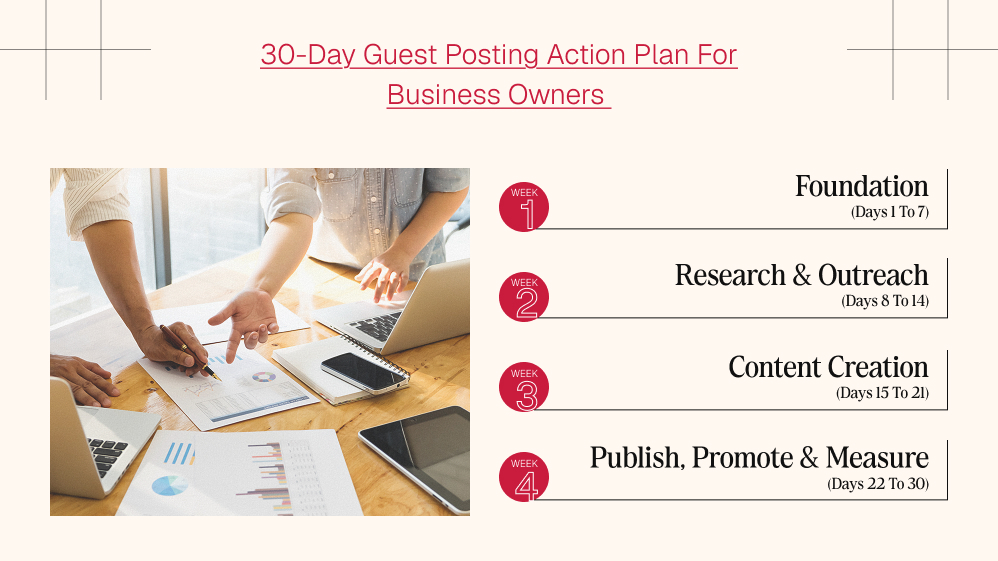
Here’s a practical 30-day blueprint for launching a guest posting campaign that delivers real, measurable guest posting ROI. Even if you are starting from scratch, you can follow this action plan:
Week 1: Foundation (Days 1 To 7)
1. Audit your current website: check page speed, mobile experience, and conversion paths.
2. Set your 3 baseline metrics: DR, monthly organic traffic, and monthly leads.
3. Define your target audience and the publications they trust (Google ‘[your niche] + write for us’).
4. Create or update your author bio with credentials, photo, and a clear CTA.
5. Design a lead magnet (1-page checklist or free guide) relevant to your service.
Week 2: Research & Outreach (Days 8 To 14)
6. Build a list of 20 target publications. At the same time, filter for DR 40+, real traffic, and editorial standards.
7. Research each editor’s name and find their email (Hunter.io, LinkedIn).
8. Write 3 personalized pitch emails. Include one paragraph each, topic + unique angle + why their readers care.
9. Send pitches; follow up once after 5 business days if there is no response.
Week 3: Content Creation (Days 15 To 21)
10. For each accepted pitch, write a 1,000 to 1,500-word post with original perspective and personal examples.
11. Include one internal link to a relevant resource on your site in the body (where editorial guidelines allow).
12. Write a compelling author bio with your CTA (free guide, consultation, or newsletter link).
13. Prepare your landing page for each campaign. Match the topic of the post.
Week 4: Publish, Promote & Measure (Days 22 To 30)
14. Submit finalized posts to editors.
15. Amplify published posts on LinkedIn, Twitter/X, and your email list.
16. Set up Google Analytics goals to track referral traffic from each publication.
17. Record all metrics in your ROI tracker spreadsheet.
18. Schedule a 90-day review date in your calendar.
Frequently Asked Questions About Guest Posting ROI
Yes, but quality matters more than ever. Google’s algorithm updates have made low-quality link schemes less effective while rewarding genuine editorial placements on authoritative sites.
How long does it take to see results from SEO? You need 6–10 high-quality guest posts before meaningful SEO movement. The more competitive your niche, the more consistent your link building will need to be.
You can absolutely do it yourself. Especially in the early stages. The DIY approach takes more time but builds genuine relationships with editors and audiences.
Agencies can accelerate placement and scale volume. But ensure any agency you hire has transparent processes and avoids private blog networks (PBNs) or link schemes that could harm your rankings.
First, check your timeline expectations. If you’re under 6 months, stay on that course. If you’re past 6 months, do an audit.
Google penalizes guest posting done purely for manipulative link building.
Disclaimer: The content in this article is provided for informational and educational purposes only and does not constitute financial, investment, legal, or professional advice


Must Read

Popular Street Bikes for Everyday Commuting

Head Of Growth Marketing Responsibilities: A Beginner’s Guide To The Role

How To Build A Growth Marketing Strategy That Actually Works

Growth Marketing For Beginners: A Simple Way To Grow Your Small Business

Growth Navigate Startup Tools: The Strategic Tech Stack Framework For Scaling US Companies
Most Popular

A Guide For Deductibles and Premiums in Accident Insurance
Financial Survival Tips for Entrepreneurs in Debt
Toronto Car Insurance vs. Other Cities: Why Are Rates So High?

The Future of MENA Businesses: Why You Need Both Management & Accounting Software


Leave A Reply