


How To Create A Business Budget For Content Sites And Guest Posting Businesses

Most people running content websites do not think seriously about budgeting until revenue starts becoming inconsistent.
That is usually when panic enters the picture.
One month looks incredible:
- Affiliate commissions rise.
- Guest posting orders increase.
- Traffic climbs.
- Sponsorship money lands together.
Suddenly, the business feels unstoppable.
And just when you are making a lot of money and things are finally going right, Google rolls out yet another core update that turns SEO Twitter into a support group.
Within a span of three months, rankings dip, a major client disappears, writers still need payment, hosting renews, and tool subscriptions hit together.
Moreover, a complete recovery of your site(s) will take time – something that you don’t have, thanks to the absence of solid financial backing.
Now the exact same business suddenly feels financially unstable. But the thing is, this cycle happens constantly in content-driven businesses.
This is especially true for businesses built around:
- guest posting,
- affiliate websites,
- SEO publishing,
- digital media sites,
- niche blogs,
- content agencies, and
- monetized informational websites.
And honestly, this is where many content businesses quietly fail. Not because traffic disappears completely.
Because the money was never managed properly once it started arriving.
How To Create A Business Budget For Content Sites And Guest Posting Businesses?
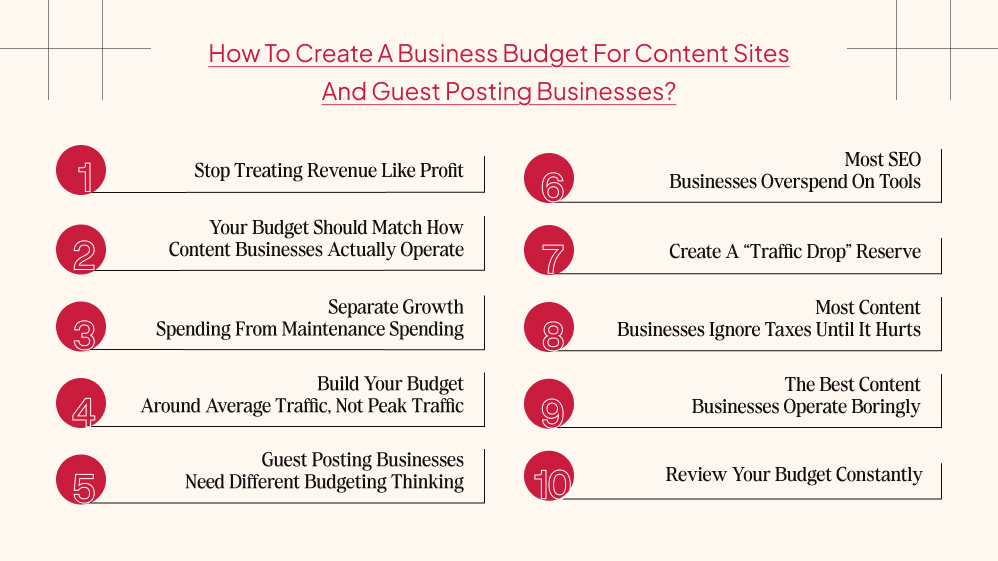
Most content site owners do not realize how fast expenses grow. This happens slowly at first. So, a website initially feels cheap to run:
- basic hosting,
- one domain,
- maybe a writing tool, and
- a few plugins.
That stage creates a dangerous illusion. Because once the site starts growing, expenses multiply everywhere:
- content writers,
- editors,
- keyword tools,
- AI software,
- plagiarism checkers,
- outreach tools,
- premium themes,
- link-building costs,
- guest posting expenses,
- email software,
- CDN upgrades, and
- server scaling.
And somehow every SEO tool online now charges as if it belongs inside a Fortune 500 company.
Also, the problem is that many content businesses scale spending emotionally instead of strategically.
So, once traffic rises slightly, five new writers get hired, expensive subscriptions get added, publishing frequency doubles, and outsourcing explodes.
And that too before the actual revenue stability exists to support any of it.
1. Stop Treating Revenue Like Profit:
This is probably the biggest financial mistake in content businesses, and this is especially true for newer ones.
For instance, a website earns $8,000 or $15,000 or even $25,000. Psychologically, founders immediately start thinking: “This business makes $25k monthly.”
But that’s not necessarily true. Because content businesses bleed money quietly through operations, especially guest posting businesses.
Moreover, people forget to account for:
- content production,
- link acquisition,
- outreach teams,
- editing,
- publishing infrastructure,
- freelancers,
- platform subscriptions,
- transaction fees,
- taxes, and
- operational reinvestment.
Also, revenue screenshots online almost never show margins. That creates unrealistic expectations everywhere.
The reality? A site generating impressive top-line revenue may secretly have terrible cash flow underneath.
2. Your Budget Should Match How Content Businesses Actually Operate:
This is where generic budgeting advice becomes useless. Most content businesses do not spend money like traditional companies.
As a result, your budgeting categories should reflect real operational behavior. For example, most serious content businesses need categories like:
- content writing,
- editorial costs,
- SEO tools,
- AI tools,
- guest posting,
- outreach operations,
- hosting infrastructure,
- affiliate operations,
- email marketing,
- design work,
- technical SEO,
- freelancers,
- traffic acquisition, and
- software subscriptions.
Please note that no vague corporate templates were downloaded from accounting blogs.
Because if the budget does not mirror how the business genuinely functions, nobody actually follows it consistently.
3. Separate Growth Spending From Maintenance Spending:
This distinction matters a lot in SEO businesses. So, maintenance spending keeps the operation alive:
- hosting,
- essential tools,
- writers,
- editors, and
- technical upkeep.
Moreover, the entire concept of growth spending exists to scale:
- aggressive content expansion,
- backlink campaigns,
- outreach scaling,
- new site launches,
- additional hires, and
- testing new traffic channels.
The problem is that many content businesses start treating growth spending like a permanent operating necessity.
That becomes dangerous during traffic downturns. And this is especially because SEO businesses are unusually volatile.
Also, Google can destroy predictable revenue faster than almost any traditional business environment, which means financial flexibility matters more than aggressive scaling most of the time.
4. Build Your Budget Around Average Traffic, Not Peak Traffic:
This mistake destroys cash flow constantly. So, a content site has one viral quarter, a strong affiliate season, and temporary ranking growth.
And suddenly the business budget gets rebuilt around best-case performance. That creates financial pressure immediately, especially once:
- RPMs drop,
- rankings fluctuate,
- affiliate programs reduce payouts,
- search intent shifts, and
- AI search changes traffic behavior.
Strong months should strengthen reserves – not permanently inflate operational costs.
The people who survive long-term in SEO usually budget conservatively because they understand traffic volatility emotionally already.
They have seen what algorithm updates can do.
5. Guest Posting Businesses Need Different Budgeting Thinking:
This is because guest posting cash flow behaves differently from traditional publishing revenue.
As a result, you are often balancing:
- publisher payments,
- client invoices,
- outreach costs,
- placement negotiations,
- operational margins, and
- content delivery timelines.
And if cash flow timing gets messy, the business becomes stressful very quickly, especially when clients delay payments, publishers require upfront payment, outreach volume increases, and operational scaling happens too fast.
That is why strong guest posting businesses obsess over cash flow management more than flashy revenue numbers. Because stable operations matter more than temporary spikes.
6. Most SEO Businesses Overspend On Tools:
This deserves its own section because the problem is absurd now.
SEO businesses collect subscriptions like trophies – One keyword tool, one crawler, one outreach platform, one AI assistant, one content optimizer, one plagiarism checker, one analytics suite, or one reporting dashboard.
Individually, each subscription feels manageable. Together, they quietly become operational weight, especially when multiple tools overlap heavily.
Also, a good business budget forces uncomfortable questions:
- Does this tool genuinely improve revenue?
- Is this solving a real operational bottleneck?
- Are we paying for convenience or necessity?
- Is the team even using this consistently?
Most online businesses have more software than they actually need.
7. Create A “Traffic Drop” Reserve:
So, you don’t need to create an emergency fund only. Instead, you need a traffic-drop reserve specifically.
It’s a completely different mindset, and I’ve actually discussed it in detail as a part of my blog on financial habits that actually work.
Traditional businesses prepare for slow sales, economic downturns, and operational emergencies.
In contrast, content businesses have additional risks. This usually includes:
- algorithm updates,
- ranking collapses,
- AI search shifts,
- affiliate changes,
- indexing problems,
- manual penalties, and
- traffic volatility.
And traffic drops affect psychology fast. Plus, without reserves, businesses start making desperate decisions, such as
- cutting quality,
- over-publishing,
- chasing trends,
- buying spammy backlinks, and
- panic monetization.
TBH, financial breathing room protects decision-making during unstable periods. And that matters enormously in SEO.
8. Most Content Businesses Ignore Taxes Until It Hurts:
This lesson arrives brutally for many website owners. Because digital income feels psychologically different from traditional income.
So, money arrives through:
- Stripe,
- PayPal,
- affiliate dashboards,
- direct invoices, and
- digital payouts.
Also, because nobody automatically removes taxes for you, the money feels fully available immediately.
The truth? It is not. A portion already belongs elsewhere, whether you mentally separated it or not.
And content businesses often make this worse by aggressively reinvesting before properly accounting for tax obligations.
Then tax season arrives. Suddenly, reserves disappear, cash flow tightens, scaling stops, and stress explodes.
Remember, good budgeting protects against that cycle early.
9. The Best Content Businesses Operate Boringly:
This surprises people.
The Internet business culture constantly glorifies scaling fast, huge screenshots, aggressive growth, and constant expansion.
But financially stable content businesses usually look surprisingly disciplined behind the scenes.
As a result, they:
- hold cash reserves,
- scale carefully,
- monitor operational costs,
- avoid emotional spending,
- protect cash flow, and
- review profitability honestly.
Because experienced operators understand something that newer creators often miss: Online traffic is unstable by nature.
This, in turn, means the business model must survive volatility without collapsing emotionally every few months.
10. Review Your Budget Constantly:
Of course, not obsessively but regularly. This is because content businesses evolve unusually fast.
So, a strategy working six months ago may already be outdated because:
- search intent shifted,
- AI changed traffic patterns,
- affiliate programs changed commissions,
- publishing costs increased, and
- operational priorities evolved.
That means budgets should evolve, too, especially around:
- ROI per article,
- guest posting returns,
- tool efficiency,
- writer productivity,
- operational margins, and
- traffic monetization.
Here, the goal is not perfection. Instead, the goal is visibility. Because businesses become dangerous financially when owners stop understanding where money is actually going.
So, How Do You Create a Business Budget That Actually Works?

The hard truth? Start with reality, not optimism. More importantly, you need to understand:
- What does the content business truly earn?
- What operations genuinely cost?
- Where does money leak quietly?
- How unstable can traffic become?
- What expenses are essential?
- What spending is emotional instead of strategic?
Then build financial systems that can survive fluctuations without panic, because making money from content websites is one skill.
However, managing that money properly while search engines, traffic patterns, and digital publishing keep changing constantly is an entirely different matter.
And the faster you understand, the better for you.


Must Read

How to Build a Modern Business Protection Strategy

Popular Street Bikes for Everyday Commuting

Head Of Growth Marketing Responsibilities: A Beginner’s Guide To The Role

How To Build A Growth Marketing Strategy That Actually Works

Growth Marketing For Beginners: A Simple Way To Grow Your Small Business
Most Popular

A Guide For Deductibles and Premiums in Accident Insurance
Financial Survival Tips for Entrepreneurs in Debt
Toronto Car Insurance vs. Other Cities: Why Are Rates So High?

The Future of MENA Businesses: Why You Need Both Management & Accounting Software


Leave A Reply