


Financial Habits That Actually Work When You Make Money Online

Making money online feels exciting right up until the moment you realize nobody taught you how to manage inconsistent income properly.
It is your financial habits that can make or break your online career. And that is where things get weird.
For instance, one month, a guest posting site suddenly performs well, affiliate commissions spike, and invoices start landing together like life finally figured itself out.
Then two months later:
- Traffic drops.
- A client disappears.
- Payouts get delayed.
- Hosting renewals arrive together.
- And Google decides your rankings apparently offended you personally.
Now the same income that felt limitless suddenly feels fragile. TBH, this cycle happens constantly in online businesses. And this is especially for people earning through:
- Content websites.
- Guest posting.
- Niche blogs.
- Affiliate marketing.
- SEO services.
- Link building.
- Digital publishing.
The internet talks endlessly about “making money online.” Almost nobody talks enough about managing it once it actually starts arriving.
And honestly, poor money management destroys more online businesses than lack of traffic ever will.
As a digital marketing professional for eight years, I can tell you one thing: earning money is all good until you learn how to manage it.
This is because without good money management, you will be stuck in a limbo for years, failing to grow your business into something long-term and sustainable.
My experience with guest posting websites and content assets has taught me some great financial habits that actually work.
And it is only fair that I share my wisdom with anyone struggling with guestposting ROI and money management for sustainable expansion.
In this blog, I’ll break down effective financial habits that will actually work – and this is for anyone who has just started making money online.
Stay tuned.
The First Mistake Most Website Owners Make:

Most websites treat temporary income spikes like permanent business growth. This happens constantly after somebody has:
- One strong affiliate month.
- A viral article.
- Successful guest posting outreach.
- A sudden SEO jump.
- A good quarter from advertisers.
Immediately, your brain starts recalculating life: “This is my new normal now.” I hate to break the truth to you, but it is usually not so.
So, the thing is, online income moves in waves, search traffic fluctuates, algorithms change, and clients disappear.
And that’s not all, RPMs can collapse randomly, platforms might update policies without warning, and entire traffic strategies die overnight sometimes.
As a result, if you build your spending and financial habits around your best month instead of your average month, things get stressful very quickly.
10 Financial Habits That Actually Work When You Make Money Online:
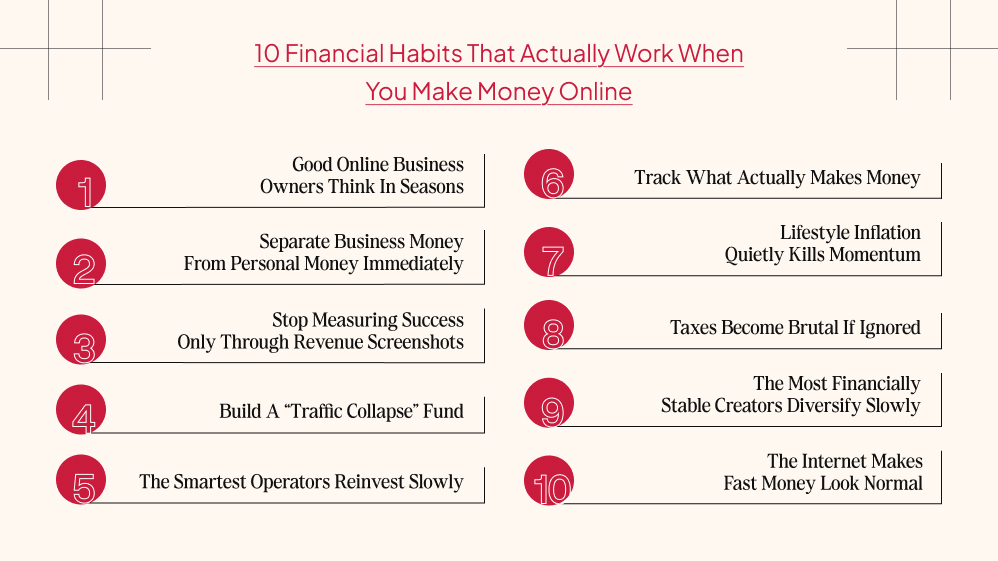
The best financial habit online creators develop is that they learn to hold cash without immediately deploying it emotionally.
This sounds simple until money finally starts arriving consistently from websites. Then suddenly the temptation appears:
- buy another course,
- launch another site,
- hire too quickly,
- purchase expensive SEO tools, and
- chase every opportunity simultaneously.
Online entrepreneurs often confuse movement with growth. But constantly reinvesting without a financial structure creates exhaustion fast.
As a result, some of the smartest website operators quietly keep larger cash reserves than people expect because they understand how volatile search-based businesses can become.
This is especially true for anyone who survives one major algorithm update. That experience changes people permanently.
And when I say I speak from experience, I mean exactly that. We were hit by the 2024 Google March Update – and while we tried to recover our sites, for 9 whole months, nothing happened.
It took us almost a year to get back a few of our sites.
Also, it’s been two years since then, and we are still working on some sites (including Emblem Wealth) to restore them to their former glory.
1. Good Online Business Owners Think In Seasons:
This changes everything. So, people who survive long-term online rarely assume consistency from internet income.
They expect fluctuation, which means during strong months, they do not immediately:
- Upgrade everything.
- Inflate lifestyle costs.
- Hire recklessly.
- Spend emotionally.
- Assume endless growth.
Instead, they create breathing room.
That breathing room matters more than people realize because online businesses are unusually unpredictable compared to traditional salaries.
And this is especially true for SEO-dependent businesses. Google can humble people professionally before breakfast.
2. Separate Business Money From Personal Money Immediately:
This sounds obvious.
Almost nobody does it early enough.
In fact, when somebody first starts making money from guest posting, niche sites, sponsored content, and affiliate commissions, everything often flows into one personal account.
Trust me, this will create chaos later. Suddenly, you cannot tell what the actual profit, business expenses, taxes owed, reinvestment capacity, monthly operating costs, and more are.
And the psychological effect becomes messy too because every payout starts feeling spendable. The truth? It is not.
A portion of online income is already reserved mentally for:
- Taxes,
- Writers,
- Hosting,
- Tools,
- Outreach,
- Domains,
- Content production, and
- Future instability.
The people who scale content businesses successfully usually become financially boring surprisingly fast. And that is a compliment.
3. Stop Measuring Success Only Through Revenue Screenshots:
Internet business culture created a terrible habit: Everyone flexes revenue. But almost nobody talks about margins.
A site earning $20,000 monthly revenue might secretly keep very little after:
- Content costs
- Backlinks
- Contractors
- Software
- Failed experiments
- Taxes
- Operational expenses
Meanwhile, another smaller site earning half as much may actually keep more profit because the system runs lean.
Revenue feels exciting online because screenshots look impressive. Cash flow stability matters more in the long term. Always.
4. Build A “Traffic Collapse” Fund:
Not just an emergency fund but a traffic collapse fund. It is a different mindset entirely.
So, traditional emergency funds assume:
- job loss,
- medical emergencies, and
- unexpected expenses.
However, website businesses have additional risks:
- ranking crashes,
- deindexing,
- affiliate program shutdowns,
- advertiser losses,
- AI search shifts,
- traffic volatility, and
- platform dependency.
As a result, if your income depends heavily on Google traffic, financial buffers stop being optional.
They become survival infrastructure because traffic drops feel much less terrifying when your business can survive six bad months without panic decisions.
5. The Smartest Operators Reinvest Slowly:
This part surprises newer creators. Beginners often assume successful site owners are constantly scaling aggressively.
But in reality, many experienced operators actually move carefully financially. Because they already know: more content does not automatically mean more profit.
In fact, sometimes people burn massive budgets:
- hiring too many writers,
- publishing low-quality articles,
- overbuilding teams, and
- chasing trends blindly.
Then, traffic never catches up enough to justify the spending. Sustainable online businesses usually grow through measured reinvestment, not emotional scaling.
6. Track What Actually Makes Money:
Track what is helping you make money – not what feels productive. This distinction matters a lot.
Moreover, a shocking number of content businesses continue spending money on activities that barely produce returns because they look impressive or competitors are doing so.
Some do it because Twitter recommended them. And for others, ‘branding’ became the excuse.
But profitable operators eventually become obsessed with one thing: return on effort. These businesses are asking the right questions:
- Which articles generate revenue?
- Which sites convert?
- Do guest posts actually move rankings?
- Which partnerships matter?
- Which expenses quietly waste money every month?
The internet rewards people who understand leverage, not just activity.
7. Lifestyle Inflation Quietly Kills Momentum:
This is probably the biggest trap once online income becomes real.
So, when somebody jumps from zero income to meaningful internet income, there is a strong urge to immediately upgrade life everywhere.
Better apartment. Better gadgets. Even better subscriptions and coffee shops. It is all about more convenience spending. And individually, none of those seems dangerous.
But recurring expenses become very heavy during weak traffic periods, especially when your business income fluctuates unpredictably.
The creators who survive long-term usually avoid building lifestyles that require peak performance income every single month. That flexibility protects them psychologically, too.
8. Taxes Become Brutal If Ignored:
Every online business owner learns this lesson eventually and usually painfully.
When income arrives digitally, it feels less “real” initially because nobody physically hands you money. That creates dangerous mental accounting.
Moreover, people spend aggressively and forget a significant percentage already belongs elsewhere.
Then tax season arrives like a horror movie plot twist. And this is especially for:
- affiliate marketers,
- freelancers,
- content site owners,
- SEO consultants, and
- guest posting businesses.
Also, good financial habits online often start with respecting taxes earlier than feels necessary because government penalties are incredibly unmotivated by your traffic fluctuations.
9. The Most Financially Stable Creators Diversify Slowly:
This isn’t because diversification sounds smart, but dependency becomes terrifying eventually.
As a result, any website owner relying entirely on one traffic source, one affiliate program, one client, or one platform eventually feels emotionally trapped by it.
That pressure affects decision-making badly.
However, financially stable operators slowly build:
- multiple traffic sources,
- multiple revenue streams,
- different websites,
- email lists,
- direct partnerships, and
- diversified monetization.
Moreover, understand it won’t happen overnight. But when done intentionally. Because stability online usually comes from reducing dependence, not chasing endless growth.
10. The Internet Makes Fast Money Look Normal:
That is part of the problem.
So, online business culture constantly showcases:
- overnight traffic growth,
- insane affiliate commissions,
- viral SEO wins, and
- huge revenue screenshots.
Moreover, what people rarely show:
- unstable cash flow,
- algorithm fear,
- financial inconsistency,
- operational stress, and
- unpredictable months.
So newer creators start assuming unstable growth is normal and sustainable. Usually, it is not. In fact, long-term operators think differently. They optimize for durability.
That mindset changes financial behavior completely.
So, What Financial Habits Actually Work?
The habits that work online are usually less glamorous than people expect.
Not flashy scaling. Not emotional spending. Also, not pretending every strong month lasts forever.
The people who survive and grow in content businesses long-term usually:
- separate business finances properly,
- hold cash reserves,
- reinvest carefully,
- prepare for volatility,
- track profitable activities honestly,
- avoid lifestyle inflation, and
- build financial breathing room.
Making money online is one skill. But keeping stability while the internet changes constantly is a completely different challenge.


Must Read

How to Build a Modern Business Protection Strategy

Popular Street Bikes for Everyday Commuting

Head Of Growth Marketing Responsibilities: A Beginner’s Guide To The Role

How To Build A Growth Marketing Strategy That Actually Works

Growth Marketing For Beginners: A Simple Way To Grow Your Small Business
Most Popular

A Guide For Deductibles and Premiums in Accident Insurance
Financial Survival Tips for Entrepreneurs in Debt
Toronto Car Insurance vs. Other Cities: Why Are Rates So High?

The Future of MENA Businesses: Why You Need Both Management & Accounting Software


Leave A Reply