


Growth Navigate Startup Tools: The Strategic Tech Stack Framework For Scaling US Companies
Building a venture-backed tech company or a high-growth business in the US market used to be about buying as many subscriptions as possible.
You signed up for enterprise CRMs, stacked disparate marketing automation platforms, paid thousands for isolated database management systems, and spent half your early-stage funding just keeping those systems connected.
In today’s macroeconomic landscape, that approach burns cash and slows down execution.
Early-stage founders cannot afford bloated software budgets. Every subscription must prove its ROI within 90 days, or it gets cut. That is where growth navigate startup tools come into play.
Using growth navigate startup tools isn’t simply about picking software apps from a top-ten list. It’s an operational framework for choosing, integrating, and optimizing your company’s technology stack so that software accelerates revenue instead of inflating burn rate.
If you are evaluating early-stage software, scaling past your initial product-market fit, or preparing your operational infrastructure for external capital, this guide maps out the modern tool ecosystem built specifically for US founders.
What Are Growth Navigate Startup Tools?

At its core, utilizing growth navigate startup tools means selecting software based on unit economics, operational velocity, and capital readiness.
Too many founders choose software based on what mega-corporations use. They install enterprise platforms that require dedicated administrators, long implementation cycles, and heavy annual contracts.
When you adopt growth navigate startup tools, you select modular, API-first platforms that scale alongside your company.
[Raw Tool Stack] → [Data Silos & Bloat] → High Burn Rate

[Growth Navigate Framework] → [Unified API Stack] → Scalable Revenue Growth
The difference comes down to three operational principles:
- Minimal Context Switching: Tools must integrate seamlessly into a single workspace, minimizing lost developer and sales time.
- Flexible Cost Structures: Software costs must scale directly with actual usage or revenue, preventing fixed-overhead traps.
- Data Portability: Customer records, financial metrics, and operational data must move freely between platforms without custom engineering.
The Core Pillars of a Scalable Startup Tech Stack
When selecting software for a growing company in the US market, avoid chasing novelty. Every tool must fall under one of four core operational pillars.
| Core Pillars of a US Startup Stack | ||
| Product & Analytics | Commercial & Go-To-Market | Capital & Financial |
| Product Analytics | CRM | Corporate Cards |
| User Tracking | Sales | Expense Management |
| A/B Testing | Marketing Automation | Accounting |
| Customer Insights | Customer Support | Payroll |
| Data Analytics | Lead Generation | Payments & Banking |
| Feature Usage | Revenue Growth | Fundraising & Equity Management |
Pillar 1: Product Development & Engineering Infrastructure
Your technical foundation dictates how fast your engineering team can ship updates, validate user demand, and address bugs.
Modern US engineering teams rely on modular foundations:
- Frontend & Frameworks: Next.js paired with Tailwind CSS for high-performance, SEO-friendly web deployment.
- Backend & Database Infrastructure: Node.js, Python (FastAPI for AI workloads), and managed PostgreSQL databases via services like Supabase or Neon.
- Authentication & Payment Gateway Integration: Clerk for identity management and Stripe for global payment processing, billing logic, and subscription management.
You need to acquire the machinery and infrastructure support to reduce debt. Meanwhile, when a lending agency checks your systems, you need to be ready with clean infrastructure!
Pillar 2: Commercial Engines & Go-To-Market Automation
You need a refined tech stack to secure US-based customers and work with them over the long term. Especially, you must possess a responsible GTM stack.
The stack should at least have lifecycle management tools, lead management tools, and sales pipeline trackers.
- Customer Relationship Management (CRM): HubSpot or Salesforce Starter for managing customer pipelines, tracking contract stages, and attributing acquisition channels.
- Product Analytics & Behavior Tracking: PostHog or Mixpanel for tracking user conversion funnels, session recordings, and feature usage patterns.
- Customer Communication: Resend for transactional emails alongside automated customer onboarding sequences.
Pillar 3: Capital Architecture & Financial Readiness
Before pursuing outside capital, your accounting and reporting engines must be transparent and precise. Messy books increase debt interest rates and trigger lower startup valuations.
- Core Accounting: QuickBooks Online or Wave for accrual-basis bookkeeping, bank reconciliations, and balance sheet preparation.
- Payroll & Compliance: Gusto or Rippling for compliant payroll execution, benefits administration, and state tax filings across multiple US jurisdictions.
- Financial Modeling & Planning: LivePlan or specialized financial modeling platforms for runway projection and scenario analysis.
When your bookkeeping is clean, secured access to non-dilutive capital becomes significantly easier. Reviewing our structural guide on growth navigate funding will show how clean books unlock lower interest rates and preserve equity during expansion rounds.
Pillar 4: Internal Knowledge & Distributed Operations
Remote and hybrid work structures dominate the US startup landscape. Without centralized documentation, operational velocity slows dramatically.
- Knowledge Architecture: Notion for unified documentation, team wikis, project boards, and investor data rooms.
- Asynchronous Communication: Slack for real-time team collaboration, webhooks, and automated system alerts.
- Workflow Automation: Zapier or Make for connecting API endpoints between platforms without custom code.
Comparing Essential US Growth Navigate Startup Tools
Evaluating software requires looking past sales landing pages. Here is how key tools compare across pricing structures, implementation friction, and operational value for US founders.
| Software Category | Top Market Choice | Best For | Implementation Time | Operational Advantage |
| Payments & Billing | Stripe | Developer-led SaaS & E-commerce | 1–3 Days | Handles multi-state US tax compliance, subscriptions, and payouts natively. |
| Product Analytics | PostHog | Product-Led Growth (PLG) | Same Day | Combines product analytics, session replays, and feature flags in one tool. |
| CRM & Sales Pipeline | HubSpot | B2B SaaS & Service Companies | 3–7 Days | Unifies marketing automation, deal tracking, and customer support databases. |
| Database & Auth | Supabase | Modern Web & Mobile MVPs | 1–2 Days | Open-source Firebase alternative providing PostgreSQL, storage, and auth out of the box. |
| Accounting & Tax | QuickBooks | Established Startups | 1–2 Weeks | Industry-standard platform expected by US CPAs, bank underwriters, and tax authorities. |
| Payroll & HR | Gusto | Distributed US Teams | 2–5 Days | Automates federal, state, and local payroll taxes across all 50 states automatically. |
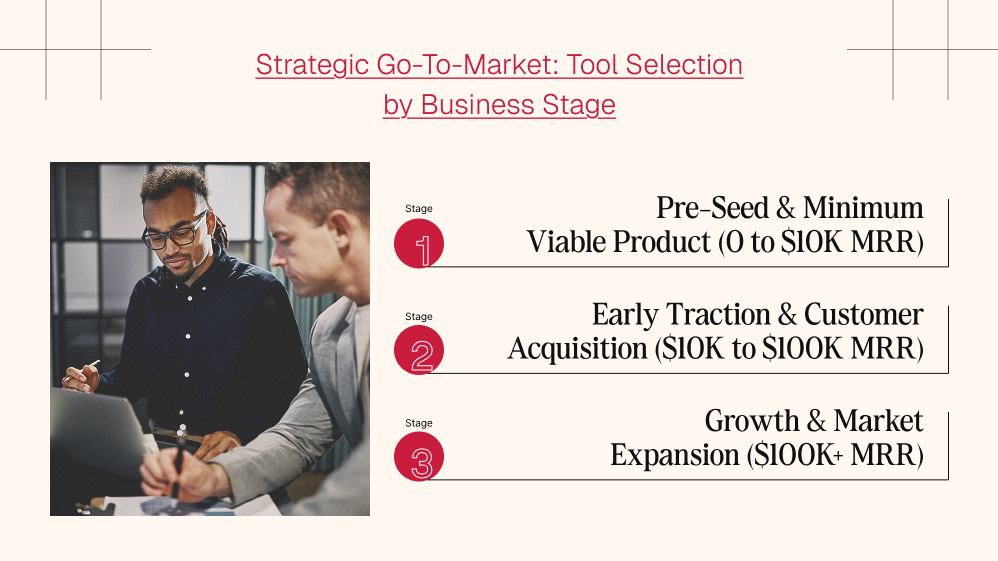
Strategic Go-To-Market: Tool Selection by Business Stage
Selecting software out of order creates operational friction. Match your tool investments directly to your current business milestone.
[Pre-Seed / MVP] ──> [Early Traction] ──> [Growth / Scale]
- Next.js / Stripe • HubSpot CRM • Enterprise Security
- Wave / QuickBooks • PostHog Analytics • Multi-State Payroll
- Notion / Slack • Zapier Automations • Custom Data Warehouses
Stage 1: Pre-Seed & Minimum Viable Product (0 to $10K MRR)
At this stage, speed is everything. Minimize fixed commitments by using free tiers and developer-focused tools.
- Focus: Build fast, validate customer demand, and keep monthly software spend under $300 total.
- Primary Stack: Next.js, Vercel, Supabase, Stripe, Notion, Wave Accounting, and Slack.
- Goal: Reach initial product-market fit without incurring unnecessary operational overhead.
Stage 2: Early Traction & Customer Acquisition ($10K to $100K MRR)
Once you confirm customer demand, shift your focus to repeatable acquisition and retention.
- Focus: Automate lead capture, track conversion funnels, and prepare clean financial statements.
- Primary Stack: Transition to QuickBooks Online, implement Gusto for compliant payroll, add PostHog for user analytics, and deploy HubSpot for pipeline tracking.
- Goal: Prove unit economics. Focus on establishing a Customer Lifetime Value (LTV) to Customer Acquisition Cost (CAC) ratio above 3:1.
For a deeper analysis of how to leverage unit economics during expansion, explore our comprehensive framework covering startup growth strategies.
Stage 3: Growth & Market Expansion ($100K+ MRR)
With proven unit economics, software tools transition from basic operational helpers into competitive moats.
- Focus: Scale outbound sales teams, optimize customer onboarding, and maintain security compliance.
- Primary Stack: Advanced CRM workflows, automated data pipelines via Snowflake or BigQuery, automated HR compliance via Rippling, and custom BI dashboards.
- Goal: Prepare for institutional growth funding or debt financing with audit-ready operational infrastructure.
Evaluating Tool ROI: The YMYL Financial Checklist
Taking on software subscriptions affects your startup’s cash burn, financial runway, and ultimate valuation. Before signing annual software contracts, evaluate every purchase against this financial checklist:
1. Does the Tool Support Usage-Based Pricing?
Avoid rigid annual contracts early on. Prioritize platforms that charge based on active seats, API calls, or transaction volume. This keeps software expenses proportional to your actual revenue.
2. What Is the True Cost of Migration?
Low upfront subscription prices can hide expensive migration costs. Consider the developer hours required to integrate a platform, train team members, and transfer historical data.
3. Does It Satisfy US Data Security & Compliance Standards?
If you process payments, handle customer data, or sell to enterprise buyers, your tool stack must comply with standard US regulations:
- SOC 2 Type II Compliance: Crucial if you sell B2B SaaS to enterprise buyers.
- PCI-DSS Compliance: Required for processing credit card transactions online securely.
- State Privacy Laws: Ensure tools respect regulations like the California Consumer Privacy Act (CCPA).
Common Tech Stack Mistakes That Inflate Burn Rate

Over the years of advising founders, we consistently see the same four technology mistakes drag down early-stage valuations.
                                Top Tech Stack Mistakes

  ┼───────────────────────────────────────┼───────────────────────────────────────┼
  ▼                                       ▼                                       ▼
Over-Engineering Architecture Ignoring Data Portability Buying Enterprise Tools Early
Mistake 1: Over-Engineering Architecture Early
Building a complex microservices architecture hosted on Kubernetes before landing your first 100 paying customers wastes engineering resources.
Start with a clean monolithic architecture or serverless edge functions. You can split services later when scaling requires it.
Mistake 2: Buying Enterprise Software Too Early
Nobody likes carrying extra baggage of admin workload. That said, an enterprise CRM tool is likely to alleviate that baggage.
However, if you use that tool when you have fewer than 10 members on the team, it will cost you otherwise.
Tracking sheets and checking data for 10 people on the dashboard is more difficult than tracking the metrics manually. So, I would recommend not installing enterprise software very early.
Mistake 3: Ignoring Data Portability
Does your software lock in customer data? Such software makes switching very difficult. So what can we do?
The best thing to do is to use the platforms that allow you to export raw data using CSV files.
Mistake 4: Disconnected Financial Reporting
Financial instruments are meant to make our lives easier. On the contrary, when you use these tools separately, it can clutter your dashboards.
For instance, your payment gateways, accounting tools and customer invoice generates separate data in real time.
Meanwhile, you need to allocate separate space in your dashboards to cite the data from these instruments separately.
Real-World Case Studies: Operational Optimization
1. How an Austin SaaS Team Cut $4,200 a Month in Burn
A seed-stage B2B software outfit in Austin, Texas, was losing $6,800 every thirty days. Why? They had a messy collection of pricey enterprise CRM seats, standalone analytics products, and custom data pipelines that kept breaking.
So, they gutted the setup. They swapped their scattered tools for a tighter stack—moving product analytics straight to PostHog, pulling customer records into HubSpot, and piping automatic billing through Stripe.
The payoff was immediate:
- Software costs dropped to $2,600 a month.
- Engineers got 75% of their pipeline-fixing time back.
- Product shipping speed doubled almost overnight.
2. An LA E-Commerce Brand Cleaned Up Its Books to Fund Growth
Over in Los Angeles, a direct-to-consumer brand was lining up a $1.5 million inventory buy. The problem was their numbers. Because their software tools didn’t talk to each other, nobody had an accurate read on unit economics.
Their fix: link Shopify directly with QuickBooks Online, move payroll over to Gusto, and set up automated inventory tracking to balance accounts receivable every single day.
When lenders checked the books, they found clean, audit-ready accrual financials. The brand scored a competitive non-dilutive inventory line of credit—and the founders didn’t have to surrender a single slice of equity.
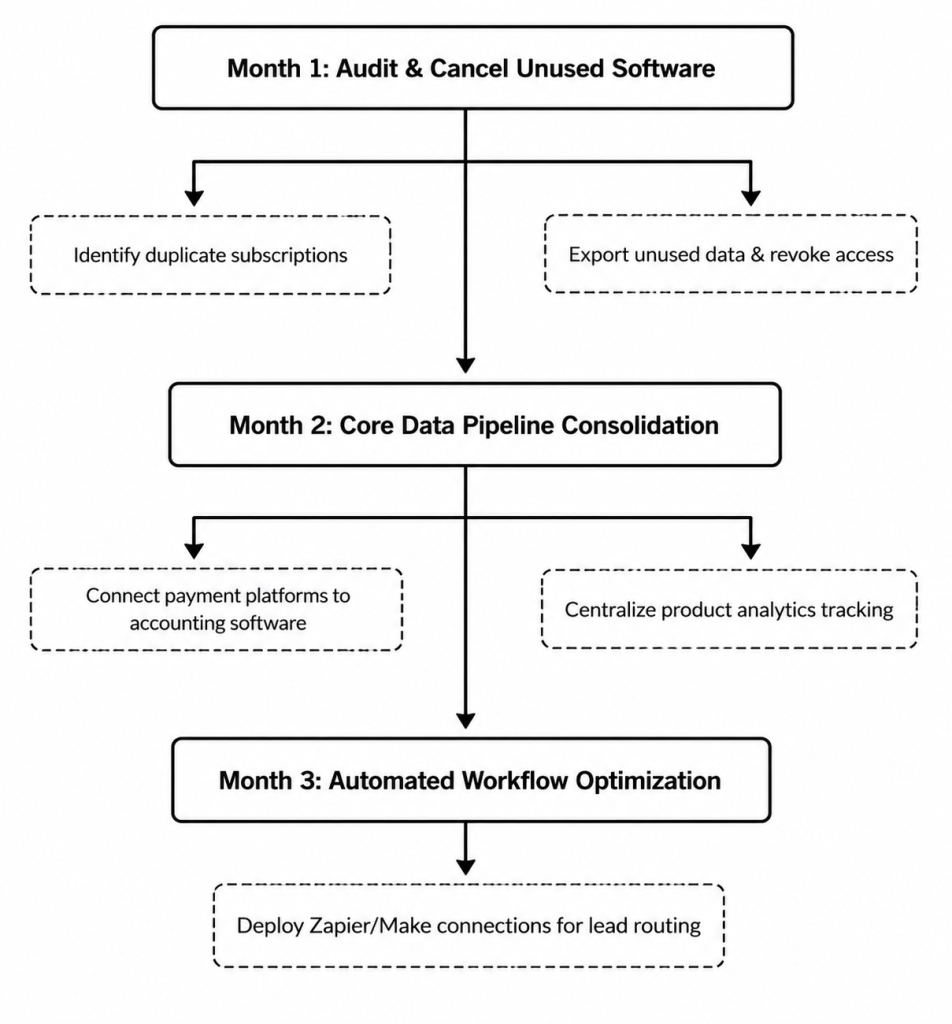
The 60-Day Playbook for Flattening Your Tech Stack
If your software stack is getting out of hand, here is how to fix it over two months without stalling daily operations:
- Days 1 to 15 (Audit & Cut): Pull your corporate credit card bills from the last 90 days. Hunt down overlapping tools, revoke unused user licenses, and grab your data exports before canceling redundant services.
- Days 16 to 30 (Fix the Core Ledger): Hook your sales channels directly into your accounting engine. Every sale needs to land in your general ledger right away using proper accrual accounting rules.
- Days 31 to 45 (Track Real Usage): Put unified product analytics across your app. Your conversion funnels, retention numbers, and churn rates should calculate themselves automatically without dev intervention.
- Days 46 to 60 (Automate the Hand-offs): Connect your tools via Zapier or built-in APIs. Set up triggers that push incoming sales leads straight into your team’s everyday chat channels so reps can jump on them immediately.
Why Investors Care About Your Tech Stack
Your stack of growth navigate startup tools isn’t just a list of monthly expenses. It directly moves the needle on your valuation when you raise cash or enter acquisition talks.
During due diligence, buyers and venture firms dig right into your underlying tools.
A simple, well-integrated setup proves that leadership keeps a tight grip on costs, avoids technical debt, and actually understands their unit economics.
Cutting subscription clutter early builds an agile, capital-efficient business that institutional investors love to back.


Must Read

Popular Street Bikes for Everyday Commuting

Head Of Growth Marketing Responsibilities: A Beginner’s Guide To The Role

How To Build A Growth Marketing Strategy That Actually Works

Growth Marketing For Beginners: A Simple Way To Grow Your Small Business

Beyond The Spreadsheet: A Float Software Review For Smart Teams
Most Popular

A Guide For Deductibles and Premiums in Accident Insurance
Financial Survival Tips for Entrepreneurs in Debt
Toronto Car Insurance vs. Other Cities: Why Are Rates So High?

The Future of MENA Businesses: Why You Need Both Management & Accounting Software



Leave A Reply