


Commercial Debt Collection In 2026: Updates, Strategies And International Framework Explained

Unpaid invoices can pose significant challenges for businesses across various sectors.
When customers do not pay on time, companies may face cash flow disruptions.
Additionally, they have to resolve issues like covering operational expenses. They also face an increased workload in managing overdue accounts.
To address these issues, commercial debt collection offers a systematic approach for businesses.
This will help businesses recover outstanding payments owed by other businesses.
Also, it will ensure professional communication and regulatory compliance.
In recent years, the process of collecting outstanding receivables has become more intricate.
In the 1990s, there was little differentiation between Business-to-Business (B2B) and Business-to-Consumer (B2C) debt collection.
But today’s landscape requires a more nuanced approach.
During that time, businesses could easily engage a collection agency or bailiff, as a simple bill from the agency was often sufficient to prompt payment.
B2B Vs B2C Commercial Debt Collection: Difference In The Legal Framework
Even though both of these are basically about collecting on the debt, the frameworks still differ significantly.
Therefore, it is always advisable that we know what these are individually, and also understand the difference between them.
| Feature | B2B Debt Collection (Business-to-Business) | B2C Debt Collection (Business-to-Consumer) |
| Debtor Type | Another company or commercial entity. | Private individual/consumer. |
| Notice of Default | Not legally mandatory, but recommended. | Strictly compulsory before taking further action. |
| Required Warning Letter | None is strictly required by law to start collection. | WIK Letter / WIK Reminder is mandatory. |
| Collection Agency Handover | Can be done immediately after the invoice deadline passes. | Only after the 14-day WIK notice period expires. |
| Mandatory Letter Content | Standard business payment terms apply. | Must explicitly detail: strict 14-day term, exact net amount, customer numbers, specific extrajudicial costs, statutory interest, VAT breakdown (if applicable), and threat of legal proceedings. |
| Proof of Delivery | Standard business communication suffices. | Highly recommended to send via both regular and registered mail to prove receipt in court. |
What Is The Process Of Commercial Debt Collection?
Commercial debt collection typically focuses on business-to-business transactions.
Also, this is completely different from the consumer collections, which involve individuals.
Rather, the commercial collections address unpaid debts between companies.
These debts often result from unpaid invoices for:
- Products
- Services
- Contractual Agreements.
Because the parties involved are businesses, the collection process usually involves different strategies and legal considerations than consumer debt recovery.
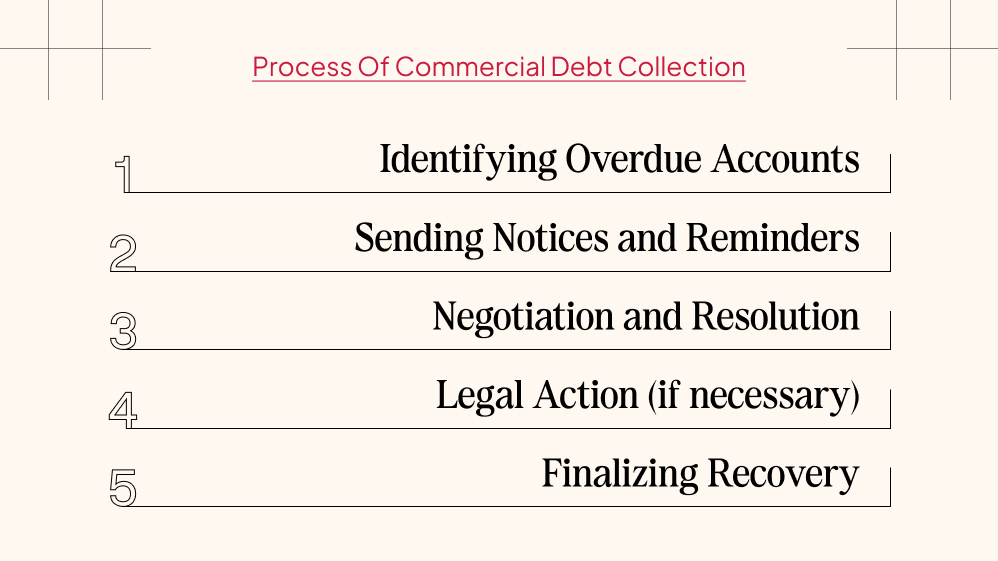
This is the entire process:
1. Identifying Overdue Accounts
Businesses actively monitor outstanding invoices to determine which accounts require follow-up.
Maintaining accurate records, including contracts, invoices, and payment terms, is essential during this process.
2. Sending Notices and Reminders
The initial outreach typically consists of friendly reminders or formal demand letters.
This communication provides debtors with the chance to settle their accounts before matters escalate further.
3. Negotiation and Resolution
In the event that payment is not received, businesses may explore negotiation options, such as repayment plans or settlements.
This approach can facilitate the recovery of funds without the immediate need for legal measures.
4. Legal Action (if necessary)
If informal attempts to collect the debt are unsuccessful, businesses might resort to legal remedies.
This could involve filing a lawsuit, obtaining a judgment, or engaging in bankruptcy proceedings.
Legal action is taken to ensure recovery is aligned with commercial and contractual law.
5. Finalizing Recovery
After payment is received or a settlement is achieved, the relevant records are updated, and the account is considered closed.
Proper documentation protects both parties involved and provides clarity for future business interactions.
Important Legal Strategies That Help During Commercial Debt Collection
In this case, you have to consult an experienced attorney. Then they would employ various legal strategies to efficiently recover debts.
These are some of the most common strategies that really work:
- Firstly, they will suggest a joint strategy of mediation and arbitration.
- Secondly, they propose litigation in state or federal courts.
- Then, they will focus on obtaining and enforcing judgments.
- They also utilize all the efficient post-judgment remedies like asset seizure and garnishment.
The Role Of Automation And AI In Commercial Debt Collection
Automation significantly enhances the efficiency of the collection process, encompassing everything from initial reminders to the transfer of accounts to external collection partners. Key benefits include:
- The automatic creation and issuance of formal notices and reminders follow a structured approach.
- The generation of digital files for seamless direct transfer to collection partners or bailiffs.
- Real-time integration with ERP or accounting systems, providing comprehensive visibility into the status of receivables.
- Automatic triggers that initiate amicable or judicial actions as needed.
While automation introduces a well-organized framework, incorporating Artificial Intelligence (AI) adds a layer of intelligence that can enhance outcomes. AI offers the ability to:
- Predict collection success rates based on factors such as payment history, industry trends, and prior interactions.
- Optimize file selection to allow collection agents or partners to prioritize the most promising receivables.
- Tailor communication strategies dynamically—adjusting tone and channels in relation to the debtor’s profile.
- Classify risk effectively, enabling automatic escalation of certain files to legal follow-up or amicable processes.
By combining automation with AI, organizations can improve overall collection strategies and increase recovery rates.
When to Hire an Agency vs. a Commercial Collection Attorney
Often, businesses get confused about whether they need an attorney or a commercial debt collection agency.
I have given a table below stating the differences and when you should hire them, so that you can make an informed decision.
| Feature | Commercial Collection Agency | Commercial Debt Attorney |
| How They Work | They use persistent phone outreach, automated email tracks, and digital tracking tools to locate debtors. | They use legal pressure, threaten formal lawsuits, and take the debtor to court if necessary. |
| How the Debtor Reacts | The debtor realizes their credit score is at risk and that the debt is being formally tracked. | The debtor takes it much more seriously, knowing an official law firm letterhead means a lawsuit is imminent. |
| Legal Power | None. They can only ask for payment; they cannot file lawsuits or force a payout. | Full Power. They can sue the debtor and get a legally binding court judgment to force payment. |
| Forcing Payment | They rely entirely on convincing the debtor to pay voluntarily. | They can legally freeze bank accounts, place liens on property, or seize assets to get your money back. |
| How You Pay Them | Usually, they take a percentage of whatever money they successfully recover. | They typically charge upfront hourly rates, flat fees, or a mix of fees and a percentage of the recovery. |
| When to Choose Them | Best for handling a high volume of smaller, undisputed unpaid invoices. | Best for large, complex debts or when the debtor actively disputes what they owe you. |
International Commercial Debt Recovery
International commercial debt recovery is the process of collecting outstanding business-to-business debts when the creditor and debtor operate under different national legal sovereignties.
According to global credit intelligence and risk managers like Coface and Atradius, the process operates in structured escalation phases.
It begins with an amicable phase focusing on out-of-court text notifications, phone calls, and structured settlement plans to preserve the business relationship.
If soft persuasion fails, the process escalates to judicial debt recovery, which is highly complex due to varying regional jurisdictions, language barriers, and currency risks.
Creditors typically pursue legal channels, using local counsel in the debtor’s country, international arbitration under the 1958 New York Convention.
This is the ones which enforces awards in nearly 200 countries.
Additionally, they resort to regional frameworks such as the European Order for Payment for uncontested claims.
Success heavily relies on preventative actions, including comprehensive documentation such as:
- Signed Contracts
- Invoices
- Delivery Notes
Also, it depends on upfront, legally binding forum-selection clauses.


Must Read

Is Bankruptcy Right for You? Questions to Ask Before Filing in Georgia

How to Build a Modern Business Protection Strategy

Popular Street Bikes for Everyday Commuting

Head Of Growth Marketing Responsibilities: A Beginner’s Guide To The Role

How To Build A Growth Marketing Strategy That Actually Works
Most Popular

A Guide For Deductibles and Premiums in Accident Insurance
Financial Survival Tips for Entrepreneurs in Debt
Toronto Car Insurance vs. Other Cities: Why Are Rates So High?

The Future of MENA Businesses: Why You Need Both Management & Accounting Software




Leave A Reply