


Shadow AI in the Mid-Market: Closing the Governance Gap

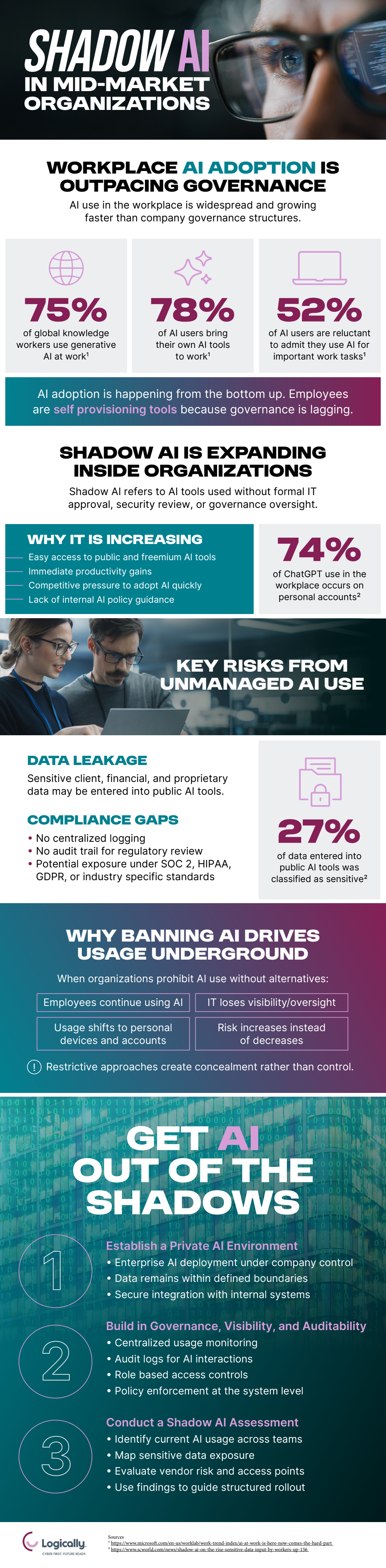
Mid-market organizations are adopting artificial intelligence at a pace that outstrips internal governance. Business units are integrating generative AI into research, drafting, analysis, and operational workflows with little centralized coordination. The intent is practical and performance driven, particularly in environments where lean teams are expected to deliver more with fewer resources. What often follows is a widening gap between how AI is used across departments and how it is governed at the enterprise level. Over time, that gap creates blind spots in risk oversight and decision-making accountability.
Shadow AI rarely begins as intentional policy avoidance. It typically emerges when employees turn to publicly available tools to solve immediate business challenges. If formal AI guidance is unclear or procurement cycles move slowly, teams adopt solutions independently. These tools may process client data, financial information, or internal documentation without review from legal or security stakeholders. As adoption spreads informally, leadership loses visibility into where AI is embedded in daily operations.
Operational and Risk Implications
Shadow AI introduces structural risk across governance, procurement, and compliance functions. From a data governance perspective, unmonitored AI usage complicates privacy obligations and contractual commitments. Without defined logging, access controls, and retention standards, organizations may struggle to respond confidently to regulatory inquiries or client audits. The issue is not only data exposure but also the inability to demonstrate control.
Procurement and vendor management functions face similar strain. Departments may license overlapping tools with inconsistent security provisions and unclear data processing terms. This fragmentation increases technology costs and weakens negotiating leverage with vendors. It also creates operational inconsistency, where different teams rely on incompatible platforms that cannot be centrally managed. Over time, this reduces the organization’s ability to build repeatable, secure AI-enabled workflows.
Establishing Structured AI Oversight
Closing the governance gap requires deliberate structure rather than restrictive bans. A private, organization-owned AI environment provides a controlled foundation for responsible adoption. Clear usage policies, defined approval pathways, and centralized visibility into AI interactions establish accountability. When governance mechanisms are embedded into the environment itself, oversight becomes operational rather than reactive.
A formal shadow AI assessment is a critical starting point. Identifying which tools are currently in use, what categories of data are involved, and which business processes depend on them provides a clear risk baseline. That baseline informs a phased rollout strategy aligned with security, legal, and executive leadership priorities. For mid-market organizations operating with limited internal bandwidth, clarity and focus are essential.
Shadow AI signals that innovation is moving faster than governance. Addressing it requires executive ownership, disciplined policy development, and practical implementation. For further perspective on building structured AI oversight within mid-market organizations, review the accompanying resource from Ingenics Services Corporation, a global staffing company.

Must Read

Is Bankruptcy Right for You? Questions to Ask Before Filing in Georgia

How to Build a Modern Business Protection Strategy

Popular Street Bikes for Everyday Commuting

Head Of Growth Marketing Responsibilities: A Beginner’s Guide To The Role

How To Build A Growth Marketing Strategy That Actually Works
Most Popular

A Guide For Deductibles and Premiums in Accident Insurance
Financial Survival Tips for Entrepreneurs in Debt
Toronto Car Insurance vs. Other Cities: Why Are Rates So High?

The Future of MENA Businesses: Why You Need Both Management & Accounting Software




Leave A Reply