


Recession-Proof Franchise Opportunities: Why Automotive Service Businesses Remain Investor Favorites

Harry and I have been neighbors for a long time. His uncle runs a small garage. Two lifts, one air compressor that groans on cold mornings, and a signboard that’s been repainted twice.
He didn’t start with venture capital or a fancy pitch deck. He started with a personal loan, a lot of unpaid weekends, and a waiting list of cars that never seemed to shrink.
That garage is still open today. It survived a fuel price spike, a pandemic, and at least two “the economy is doomed” news cycles.
And that, in one story, is the whole case for why an automotive service business keeps showing up on investor shortlists. Not because it’s attractive, but because it’s stubborn.
This article isn’t a list of franchise brand names and their entry fees. You can find twenty of those already.
Instead, we’re going to walk through the part almost nobody explains properly: how the financing actually works, what the real numbers look like, and how to know if you personally are ready to put money into one. We have explained every piece of jargon and each formula.
The Real Reason This Business Refuses To Slow Down
If you have a car, you cannot ignore the repairs. That’s a recurring expense. Meanwhile, that’s the entire economic engine behind this sector.
People delay a vacation. They delay a new phone. But, they almost never delay getting their brakes fixed when the car starts making that metallic screech on the way to work.
This single behavioral fact is why the global automotive service market is projected to reach roughly $771.6 billion in 2026, according to Fortune Business Insights. It’s also why that number keeps climbing even in years when other retail categories shrink.
Zoom into markets with young, motorbike-and-car-heavy populations, and the picture gets even more interesting.
The same research pegs one large South Asian market at close to $64.4 billion in 2026, already accounting for over 8% of global automotive service revenue.
The number is driven by rising vehicle ownership and, notably, more people choosing preventive servicing instead of waiting for something to fail.
Meanwhile, in dense Gulf cities, vehicle ownership has crossed 500 cars for every 1,000 residents according to Gulf Research Center data.
However, the desert heat chews through tires, batteries, and cooling systems far faster than milder climates do. Extreme weather is basically a built-in demand generator for an automotive service business in that region.
Here’s the part beginners miss: an aging car fleet is good news for this industry, not bad news. Older cars need more parts replaced, more diagnostics run, more labor hours billed.
A five-year-old car and a fifteen-year-old car are not the same customer. To clarify, the older one is worth more to a well-run shop over its lifetime.
What Keeps the Lights On: Recurring Revenue You Can Actually Predict
Most businesses guess at demand. An automotive service business gets to forecast it, because manufacturers already publish the maintenance schedule for you.
| Service | Typical Interval | Why It Repeats |
| Oil and filter change | Every 5,000–10,000 km | Manufacturer warranty compliance |
| Brake pad inspection | Every 15,000–20,000 km | Safety regulation and wear |
| Battery check | Every 12–18 months | Heat and cold both degrade batteries |
| Tyre rotation/replacement | Every 20,000–40,000 km | Uneven wear from road conditions |
| AC servicing | Seasonal, 1–2x per year | Climate-driven, especially in hot regions |
This is why an automotive service business is described as having “built-in” repeat customers.
You’re not chasing a one-time sale. You’re managing a calendar of return visits that the customer’s own dashboard reminds them about.
Money Talk: How People Actually Fund This Business
Now for the part your search results probably skipped. Let’s talk about actual money, in plain language.
When people say “collateral,” they simply mean something valuable. For instance, property, gold, or equipment.
In other words, it’s something that you promise to hand over if you can’t repay a loan. It’s the bank’s insurance policy against you defaulting.
Jargon-buster: “EMI” stands for Equated Monthly Instalment. It’s just the fixed monthly amount you pay back on a loan, combining a slice of the original amount (principal) plus interest.
If you borrow ₹10 lakh at 10% interest over 5 years, your EMI comes out to roughly ₹21,250 a month. Again, that’s a number any bank’s EMI calculator will spit out instantly, no maths degree required.
Jargon-buster: “Break-even point” means the exact moment your monthly revenue equals your monthly costs. Before that point, you’re paying to stay open. After it, every extra rupee, dirham, or riyal is profit.
The formula is simple: Break-even (in customers) = Fixed Monthly Costs ÷ Average Profit Per Service.
If your rent, salaries, and utilities total $4,000 a month, and you clear $50 profit per service on average, you need 80 services a month just to break even.
Once those three ideas make sense, the financing conversation stops feeling intimidating.
Three Financing Paths People Actually Take
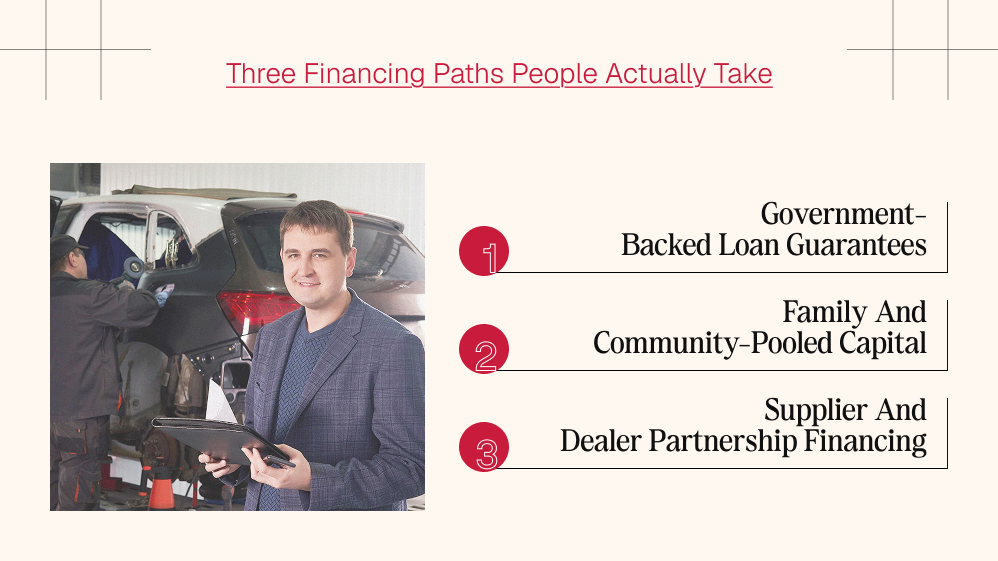
Grouped for anyone specifically asking “how do I fund an automotive service business without giving up ownership”:
Government-Backed Loan Guarantees
In several South Asian and Gulf economies, governments actively want small service businesses to survive, because they create local jobs.
Saudi Arabia’s Kafalah program, for example, has issued guarantees exceeding SAR 13.9 billion in a single year to help small enterprises borrow without full collateral, according to the Saudi Press Agency.
Similar collateral-light micro-loan schemes exist for small entrepreneurs across South Asia. The mechanism is always the same: the government tells the bank, “lend to this person, and if they default, we’ll cover part of the loss.”
That reduces the bank’s risk, which means you don’t need a house to put up as security.
Family And Community-Pooled Capital
This one rarely gets written about in Western business media, but it’s how a huge share of automotive service businesses in South Asian and Middle Eastern communities actually get started.
Gold jewelry gets pledged for a short-term bridge loan. A brother-in-law who works abroad wires savings home. It’s informal, it’s fast, and it comes with zero paperwork.
But it also comes with real relationship risk if the business struggles, so treat family capital with the same seriousness as a bank’s money, not less.
Supplier And Dealer Partnership Financing
Some parts distributors and tyre manufacturers will help finance equipment or initial inventory for a new automotive service business. In exchange for an exclusive supply agreement.
You get cheaper entry costs. On the other hand, they get a guaranteed buyer. Read the exclusivity clause carefully before signing. A final warning: cheap financing that locks you into overpriced parts for ten years isn’t actually cheap.
Comparing Your Financing Options At A Glance
| Financing Route | Collateral Needed | Speed | Best Suited For |
| Government-guaranteed bank loan | Low to moderate | Weeks | First-time owners with no major assets |
| Family/community funding | Usually none (trust-based) | Fast | Small, single-bay garages |
| Supplier/dealer partnership | Low | Moderate | Owners comfortable with brand exclusivity |
| Traditional bank loan | High | Slow | Owners with property or fixed deposits to pledge |
Are You Financially Ready? A Quick Self-Check
Before signing anything, answer these five questions honestly. Double-check your financial readiness before you start!
- Do you have savings that could cover your household expenses for at least six months if the business earned nothing?
- Have you actually spoken to a mechanic, parts supplier, or existing shop owner about real local costs, not just numbers from an online article?
- Do you know your break-even number (using the formula above) for your specific city and rent?
- Is your financing source (bank, family, or supplier) something you could realistically repay even in a slow month?
- Have you checked local licensing, pollution control, and labor requirements, or are you assuming “someone will guide me later”?
If you answered “no” to two or more, that makes some things apparent. You have to fix those areas before you begin. Fix those gaps before you fix a single carburetor.
Five Costs Beginners Always Underestimate
Grouped separately, because these answer a different search intent — “how much does it really cost to start an automotive service business”:
- Diagnostic equipment upgrades. Modern cars, even budget models, run on computer systems. A basic OBD scanner is cheap; the software subscriptions to keep it updated for new car models are not, and they renew every year.
- Environmental compliance. Used oil, coolant, and old batteries can’t just go in a regular bin in most regions anymore. Proper disposal contracts cost money monthly, not once.
- Technician training time. A new hire isn’t productive on day one. Budget for at least four to six weeks of reduced output while they learn your specific tools and workflow.
- Seasonal inventory swings. In hot climates, AC parts and coolant sell heavily for months and barely move the rest of the year. Cash gets tied up in stock that only earns during specific seasons.
- Customer trust-building period. Expect six to twelve months of thinner margins while word-of-mouth builds. First-time customers rarely pay premium rates; loyal repeat customers do.
A Real-World Comparison: Two Different Starts
Priya, in a mid-sized Indian city, started her two-bay garage with a ₹10 lakh Mudra-style micro-loan and her father’s retirement savings as a buffer, not as capital she spent.
She kept her day job as a delivery supervisor for the first eight months, working the garage on weekends until it could support one full-time technician’s salary on its own.
Her approach is slow and traditional. However, that helped her to overcome all financial hurdles. To clarify, she never missed a loan installment.
In another occasion, Omar, in a Gulf city, partnered with a tyre distributor for his initial equipment in exchange for a three-year exclusive supply deal. He launched faster and with less personal cash at risk.
But his profit margin on tyres is roughly 8% lower than a fully independent shop’s would be. That’s the price of that early speed.
Both approaches are legitimate. Neither is “correct” in isolation. The right financing path depends entirely on your personal risk tolerance and your existing cash cushion, not on which article told you to do it a certain way.
Common Mistakes To Avoid
- Borrowing the maximum amount a bank offers, simply because it was offered
- Skipping a written partnership agreement with family investors because “we trust each other”
- Underpricing labour to win early customers, then struggling to raise prices later
- Ignoring working capital needs and spending every rupee or dirham on equipment upfront
Frequently Asked Questions (FAQs):
Yes, provided you hire skilled technicians and focus your own energy on operations, customer relationships, and finances. Plenty of successful owners have never changed their own oil.
A reasonable minimum is six months of personal living expenses plus a small buffer for unexpected repairs to your own equipment, kept completely separate from business capital.
Generally yes. Programs like Saudi Arabia’s Kafalah exist specifically to reduce the collateral burden on small enterprises that banks would otherwise consider too risky to lend to without security.
Confusing revenue with profit. A busy shop can still lose money if labor costs, rent, and loan installments aren’t tracked against actual profit per service, not just the top-line number.
Quick Lessons For Beginners
An automotive service business isn’t exciting in the way a tech startup pitch sounds exciting. There’s no dramatic hockey-stick growth story. Rather, you can look at it as a business built on a chronic requirement that will never fade.
If you finance it carefully, price it honestly, and give it the same six-to-twelve months of patience every real business needs, an automotive service business remains one of the steadiest bets a first-time entrepreneur can make.


Must Read

Popular Street Bikes for Everyday Commuting

Head Of Growth Marketing Responsibilities: A Beginner’s Guide To The Role

How To Build A Growth Marketing Strategy That Actually Works

Growth Marketing For Beginners: A Simple Way To Grow Your Small Business

Growth Navigate Startup Tools: The Strategic Tech Stack Framework For Scaling US Companies
Most Popular

A Guide For Deductibles and Premiums in Accident Insurance
Financial Survival Tips for Entrepreneurs in Debt
Toronto Car Insurance vs. Other Cities: Why Are Rates So High?

The Future of MENA Businesses: Why You Need Both Management & Accounting Software



Leave A Reply