


Bootstrapped Startup Fundraising Strategy: The Complete Guide For Founders Starting From Zero
Most founders don’t raise money the way pitch deck templates show. They raise it in fits and starts, often while doing three other jobs at once.
If you’ve ever Googled “startup booted fundraising strategy” at 1 a.m. because your runway is shrinking and your investor meetings keep getting pushed back, this guide is for you.
We’re going to skip the buzzwords. No “synergy,” no “unlock value,” no vague talk about “crushing it.” Instead, we’ll walk through everything a founder actually needs before raising money.
Let us learn:
- What a startup booted fundraising strategy looks like in practice
- When to raise
- How much to raise
- Which funding types exist
- What investors actually check
- The mistakes that quietly kill otherwise good companies.
What Is A Bootstrapped Startup Fundraising Strategy?
A startup booted fundraising strategy is an approach in which a founder grows the business primarily on its own revenue and savings, then raises outside capital only after specific, measurable milestones demonstrate the business is worth funding. It flips the usual order of growth first, capital second, rather than raising money to find growth.
That’s the whole idea in one paragraph.
Why “Bootstrapping” Is Better Than “Borrowing” In The Early Days
A bootstrapping startup relies mainly on its own revenue, personal savings, or small amounts of outside capital, rather than large early investment rounds.
A startup booted fundraising strategy takes that same self-reliant instinct and applies it specifically to how and when you raise money. To clarify, you don’t chase capital just because it’s available. You chase it when it actually moves the business forward.
This matters because a lot of founders raise too early, spend too fast, and end up answering to investors before they’ve even figured out what their customers actually want.
A disciplined bootstrapped startup fundraising strategy flips that order. You prove something small first. Then you raise.
When Should You Raise Money?
This is one of the most searched questions in early-stage fundraising. However, it doesn’t have a single answer. Meanwhile, there’s a reliable checklist that most successful raises share.
You’re generally in a strong position to raise when:
- Your product works reliably, without constant hand-holding from your team
- Customers are paying, not just trialing, but renewing or repeat-purchasing
- You can see early retention, even if it’s a small sample size
- Growth is somewhat repeatable. You can point to a channel or process that worked more than once
- Your core metrics are trending the right direction, even slowly
- You know exactly what the new money would fund. Not “growth” in the abstract, but specific hires, tools, or campaigns
If most of those are missing, that’s not a failure.
It usually means the better move is to spend a few more months bootstrapping before you start a fundraising process. Simply put, investors will ask about every one of these points directly.
Types Of Startup Funding
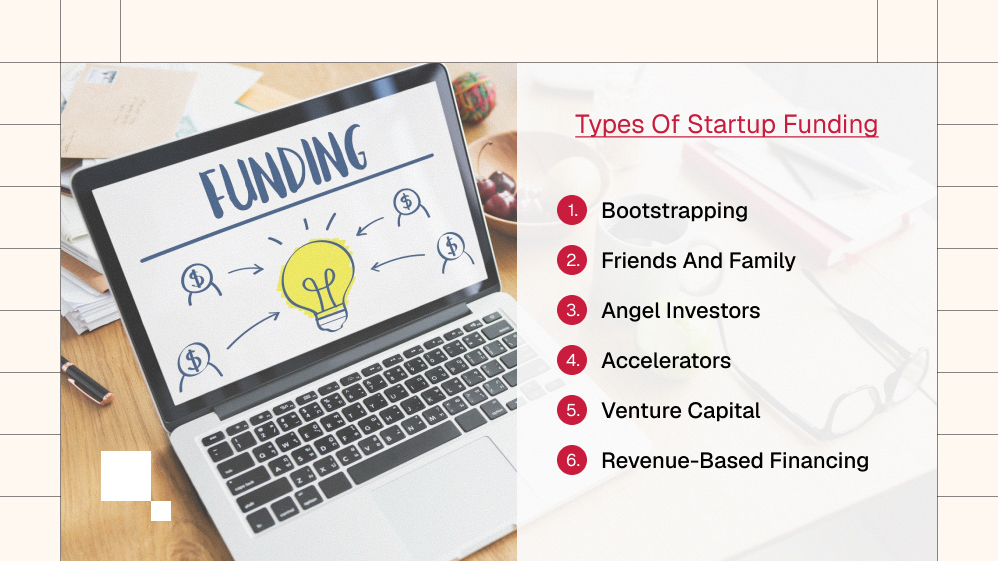
A bootstrapped startup fundraising strategy doesn’t mean “never take outside money.” It means understanding all the available funding types and choosing deliberately, rather than defaulting to whichever one sounds most impressive.
Bootstrapping
You fund the business with your own revenue, savings, or a small personal loan. The advantage is full control with no investor to answer to. Above all, no equity given away. The disadvantage is speed: growth is capped by how much cash the business itself generates, which can mean missing a market opportunity while you build up cash reserves.
Friends And Family
Often the first outside money a founder ever takes. It’s usually fast and flexible, with fewer formal terms than institutional capital. The risk is personal, not financial. In the same vein, a failed business can strain relationships that matter more than the money did.
Angel Investors
Individual investors, often former founders themselves, who write checks typically ranging from a few thousand dollars to around $100,000, sometimes more. Angels are usually appropriate once you have some early traction.
For instance, if you have a working product and a handful of paying customers. However, before you’re ready for a full venture round.
Accelerators
Programs like Y Combinator or Techstars offer:
- a small amount of capital
- a fixed-term mentorship program
- access to a network, usually in exchange for a small equity stake
They help most when a founder needs structure, accountability, and warm introductions to later-stage investors. Less so if you already have a clear go-to-market plan and just need capital.
Venture Capital
Institutional money meant for companies aiming at large, fast, venture-scale outcomes. Venture capital is well-suited to businesses with a large addressable market and a growth trajectory that can plausibly return the fund many times over.
It’s generally the wrong fit for steady, profitable, and smaller-scale businesses. To sum up, the growth expectations and board dynamics that come with VC money can actively work against a business that isn’t trying to grow at that pace.
Revenue-Based Financing
Revenue-based financing is an increasingly popular alternative to traditional equity. Instead of giving up ownership, you get upfront capital in exchange for a percentage of your future revenue until a fixed repayment cap is met. It’s an ideal option for startups with predictable, recurring revenue that want growth capital without diluting their shares.
Grants
Grants are a type of non-dilutive funding. That is to say that you keep 100% of your equity. In the same vein, grants are offered by government programs, industry bodies, or innovation funds.
In the U.S., the Small Business Administration and regional Small Business Development Centers are common starting points for founders researching what’s available in their state or sector.
Grants are slower and more paperwork-heavy than other funding types, but they’re worth the effort specifically because they cost you no ownership.
Funding Types At A Glance:
| Funding Type | Equity Given Up | Speed | Best Fit |
| Bootstrapping | None | Slowest | Founders who want full control |
| Friends & family | Usually none (or informal) | Fast | Very early, small amounts |
| Angel investors | Small | Medium | Early traction, pre-Series A |
| Accelerators | Small, fixed | Medium | Founders who want structure and network |
| Venture capital | Significant | Slower | Large markets, venture-scale ambition |
| Revenue-based financing | None | Medium | Predictable recurring revenue |
| Grants | None | Slowest | Founders with time for paperwork |
Startup Funding Stages Explained
Most beginners have heard these terms without knowing what sets them apart. Here’s the general pattern, though real-world lines blur constantly:
| Stage | Typical Purpose | Possible Funding Range (US, general) | Typical Funding Range (INR Equivalent) |
| Pre-seed | Building an MVP, validating the initial idea | $50K – $500K | ₹47 Lakh – ₹4.7 Crore |
| Seed | Finding product-market fit, first paying customers | $500K – $3M | ₹4.7 Crore – ₹28.6 Crore |
| Series A | Scaling a proven model, building out the team | $3M – $15M | ₹28.6 Crore – ₹143 Crore |
| Series B | Expanding into new markets or segments | $15M – $50M | ₹143 Crore – ₹477 Crore |
| Series C+ | Aggressive growth, acquisitions, pre-IPO scaling | $50M+ | ₹477 Crore+ |
In the Indian ecosystem, local Pre-seed/Seed rounds can sometimes be slightly lower than US standards due to lower initial operational and engineering overheads, but the above conversion holds true for global standards.
These ranges shift constantly with market conditions. Therefore, you must treat them as a rough mental map, not a rulebook.
How Much Money Should You Raise?
This is a section most guides skip, and it’s usually the one founders need most. A useful starting formula:
Runway = Cash on hand ÷ Monthly burn rate
If you have $120,000 in the bank and you’re spending $10,000 a month, you have twelve months of runway.
Most advisors suggest raising enough to cover 18 months of operation, which gives you room to hit meaningful milestones and still have a cushion before you need to raise again.
A simple way to size a raise:
| Category | Example Allocation (18-month raise) |
| Hiring | 35% |
| Marketing and sales | 25% |
| Product development | 20% |
| Operations | 10% |
| Legal and admin | 5% |
| Emergency reserve | 5% |
The exact split depends entirely on your business, but the emergency reserve line is worth keeping non-negotiable.
Founders who raise down to the exact dollar of their spending plan, with no buffer, are the ones who end up back at the negotiating table earlier than they wanted to be.
SAFE Notes And Convertible Notes, Explained Simply
A SAFE note (Simple Agreement for Future Equity) is a contract in which an investor provides you with capital now in exchange for the right to receive equity later, typically when you raise a priced round.
A convertible note works similarly but is technically a loan, with interest and a maturity date, that also converts to equity later.
| Feature | SAFE Note | Convertible Note |
| Legal structure | Not a loan | A loan (debt instrument) |
| Interest | None | Usually accrues interest |
| Maturity date | None | Has a set date it must convert or be repaid |
| Complexity | Simpler, faster to sign | More legal steps involved |
| Common use | Early pre-seed/seed rounds | Also common early, especially outside Silicon Valley norms |
Neither is inherently better. To clarify, they’re just different tools, and many early-stage rounds use one or the other depending on investor preference and regional norms.
Understanding Equity Dilution
Equity dilution occurs when your ownership percentage decreases each time you issue new shares to investors. You don’t lose existing shares. You own the same number of shares in a company that now has more total shares outstanding, which shrinks your percentage.
Here’s a simple walkthrough:
- You start owning 100% of your company.
- You raise a round that gives investors 20% of the company.
- That means you now own 80%.
- You raise again, giving new investors another 20% of the company as it now stands.
- You now own roughly 64%.
Each raise shrinks your slice, even though the company itself is growing. This is exactly why a startup booted fundraising strategy treats every raise as a deliberate trade, not a free win.
A Quick, Honest Approach For Valuation
Valuation deserves a plain-language explanation, not false precision. Nobody, including experienced investors, calculates it with total accuracy at the early stage.
Two terms come up constantly:
- Pre money valuation: what the company is considered worth before new investment is added.
- Post money valuation: the previous value plus the amount just raised.
Early-stage valuations are usually estimated using a mix of comparable companies at a similar stage, current traction, revenue (if any), and the competitiveness of the round among investors.
If someone quotes you a valuation with suspicious precision like “we’re worth exactly $4.2 million”, treat it as a starting point for negotiation, not a fact
Real-World Scenarios: Three Founders, Three Outcomes
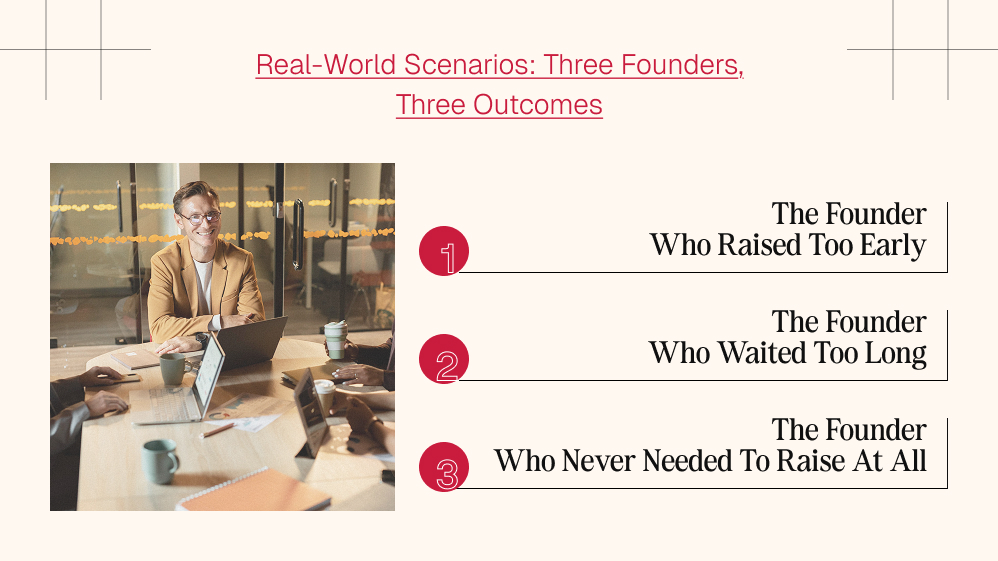
Numbers and definitions only go so far. These next three scenarios are composite cases. To clarify, they are blends of patterns that recur across early-stage companies, not single people’s stories, but realistic pictures of what founders in each situation typically face.
The Founder Who Raised Too Early
Let me tell you an incident that occurred with a two-person software company, six months old, with a working product and eleven paying customers. Revenue was real but small. To clarify, it was about $4,000 a month.
The founders assumed investors would be excited about the traction. They weren’t. In meeting after meeting, the response was polite but consistent: “Come back when you’re at $10K MRR.”
What changed the outcome wasn’t a slicker deck. Rather, it was a shift in focus. Instead of spending the next two months fundraising, the founders spent it on customer interviews and small pricing experiments.
Three months later, MRR was at $9,200, churn had dropped, and the same investors who’d said “come back later” were returning emails within a day.
The Founder Who Waited Too Long
Let’s take the example of a home goods brand bootstrapped for two years, refusing all outside capital on principle. The products were good, reviews were strong, and revenue grew steadily, but slowly.
The reason was that there was no cash for inventory at scale. A larger competitor noticed the gap and launched a similar line with far more marketing muscle.
Within six months, the smaller brand’s growth flattened. A small, well-timed raise a year earlier is enough to buy inventory ahead of a seasonal spike. The same would likely have let the company capture more of the market before a competitor moved in.
The Founder Who Never Needed To Raise At All
Now, we will talk about a B2B services company that reached profitability within its first year by keeping the team small and charging enough from day one to cover real costs. Investors occasionally reached out, curious about the traction.
The founder turned down every offer. However, it was not an arrogant move. The business didn’t need the money.
Every dollar of growth was already funded by paying customers, and taking outside capital would have meant giving up equity and control for a problem that didn’t exist.
Not every good business needs a round. That’s a legitimate outcome of a startup booted fundraising strategy, not a failure to raise capital.
The Financial Modeling
If there’s one part of this process founders avoid, it’s the numbers. Startup booted financial modeling sounds intimidating. But at the early stage, it doesn’t need to be complicated. Rather, it needs to be honest.
A simple, workable bootstrap financial model must answer four core questions:
- What is your true runway? Exactly how many months of survival do you have left at your current burn rate?
- What is your target milestone? What does your revenue need to look like in six months to justify a raise?
- Where will the capital go? What are the exact named hires, tools, and campaigns this money unlocks?
- What is your Plan B? Can the company survive on its own revenue if you raise absolutely nothing?
That last question is the one most founders skip. And it’s often the most important one. Investors ask it constantly, in different words: “What’s your plan B?”
If your only answer is “we’d have to shut down,” that’s a weak position to raise from. A credible bootstrapped startup fundraising strategy always includes a version of the plan that doesn’t depend on outside money at all.
Even if you hope you never need to use it.
Investor Readiness Checklist
Before you start outreach, most experienced investors expect you to have the following ready:
- Pitch deck (10–15 slides, not more)
- Financial model, including a no-raise scenario
- Cap table showing current ownership
- Revenue history and current MRR/ARR
- Notes from real customer interviews
- A working product demo
- A data room with core documents organized
- Key metrics tracked and current (churn, CAC, runway, burn rate)
- A clear answer for how much you’re raising and why
Missing two or three of these does not men you will be disqualified. However the steps helps you prove that you started ideation and brainstorming much earlier.
What Investors Actually Look For
Strip away the pitch-deck theater, and most investors are evaluating a short, consistent list:
- Market size: It is the opportunity big enough to matter, even if you’re small today?
- Traction: Checking if real customers already pay, and do they stick around?
- Founder-market fit: Do you have a credible reason to be the one solving this problem?
- Retention: Are customers staying, or quietly leaving after the first month?
- Revenue quality: Is growth coming from repeatable channels, or one-off spikes?
- Execution speed: How much have you shipped and learned relative to your time and resources?
Every question an investor asks in a meeting is usually a variation on one of these six points.
Questions Investors Will Actually Ask You
Preparing honest answers to these in advance saves you from freezing in the room:
- Why now: Why is this the right moment for this idea?
- Why you: What makes your team credible for this specific problem?
- But, why this market: How big is it, really, and how do you know?
- What’s your customer acquisition cost, and is it trending down or up?
- What’s your churn, and what’s driving it?
- Finally, what’s your runway, and what happens if this raise takes longer than expected?
- If successful, why won’t a larger competitor just copy this?
What Investors Review During Due Diligence
Once a term sheet is on the table, expect investors to check the substance behind your pitch. That typically includes:
- Financial statements and bank records
- Customer contracts and churn history
- Legal documents, including incorporation paperwork
- Your cap table, in full detail
- Tax filings
- Any intellectual property agreements
- Background on the founding team
Founders who keep these organized from day one move through this stage far faster than founders scrambling to assemble it under time pressure.
Startup Metrics Every Founder Should Know
You don’t need an accounting degree to speak this language. Here’s the short version of each term that comes up constantly in fundraising conversations:
| Metric | What It Means |
| MRR | Monthly recurring revenue: predictable income you collect every month |
| ARR | Annual recurring revenue: MRR multiplied by twelve |
| CAC | Customer acquisition cost which is the total cost to acquire one paying customer |
| LTV | Lifetime value, i..e., total revenue you expect from a customer over time |
| Burn rate | How much cash your business spends per month |
| Runway | How many months you can operate before running out of cash |
| Gross margin | Revenue minus the direct cost of delivering your product, as a percentage |
| Churn | The percentage of customers who leave in a given period |
| Retention | The inverse of churn, i.e., the percentage of customers who stay |
| Payback period | How long it takes to earn back what you spent acquiring a customer |
| Net revenue retention | Revenue growth or shrinkage from existing customers over time, including upgrades and downgrades |
Rough Benchmarks Worth Knowing
These vary a lot by industry, so treat them as general reference points rather than hard rules:
| Metric | Rough Healthy Benchmark |
| Monthly churn (SaaS) | 1–3% |
| Runway | 12–18 months |
| CAC-to-LTV ratio | 1:3 or better |
| Gross margin (software) | 70–85% |
| Burn multiple | Under 2 |
Common Mistakes New Founders And New Bloggers Make In This Space
Anyone writing or reading about fundraising for the first time tends to fall into a few predictable traps. It’s worth naming them directly, because avoiding them will save you time and credibility.
| Mistake | Why It Backfires | Better Approach |
| Treating “raising money” as the goal itself | Capital is a tool, not a milestone worth celebrating on its own | Tie every raise to a specific, measurable business outcome |
| Copying valuation numbers from unrelated companies | Every market and stage is different; borrowed numbers mislead both founders and readers | Base numbers on your own revenue, growth rate, and comparable-stage deals |
| Writing about fundraising with no mention of failure or rejection | Real fundraising involves a lot of “no.” Pretending otherwise reads as inexperienced or dishonest | Include the rejections and what changed afterward |
| Overusing dramatic language (“crushed it,” “10x growth,” “game-changing”) | It sounds like marketing copy, not lived experience, and readers can tell | Use specific, checkable numbers instead of adjectives |
| Ignoring the boring financial mechanics | Skipping cash flow and runway details makes advice feel theoretical | Walk through the actual math, even if it’s not exciting |
New bloggers in the finance and startup space especially tend to over-promise. They’ll write headlines like “How I Raised $2M in 30 Days” without explaining the eighteen months of groundwork that led up to that thirty-day window. However, the readers can tell the difference between earned insight and repackaged hype.
Startup Growth Strategies That Support A Fundraising Push
A startup’s fundraising strategy doesn’t exist in isolation. It’s built on top of startup growth strategies that create something worth funding in the first place.
A few patterns show up repeatedly across early-stage companies that eventually raise successfully:
- Narrow the customer before widening the market. Founders who try to serve “everyone” early on usually end up serving no one particularly well. The companies that raise successfully tend to have a tightly defined first customer segment they understand deeply.
- Let revenue set the pace, not ambition. Growth that’s funded by actual paying customers, even if it’s slow, tends to be more convincing to investors than growth funded entirely by ad spend or discounts.
- Build a habit of tracking the same three or four metrics weekly. Founders who can rattle off their churn rate, customer acquisition cost, and monthly recurring revenue without checking a spreadsheet come across as far more credible than founders who have to look everything up mid-meeting.
A Sample Fundraising Timeline
Fundraising almost always takes longer than founders expect. A realistic timeline for a typical seed round looks something like this:
| Month | Focus |
| Month 1 | Prepare: build the deck, tighten the financial model |
| Month 2 | Finalize financial model and data room |
| Month 3 | Begin investor outreach and warm introductions |
| Month 4 | First meetings and follow-ups |
| Month 5 | Term sheet negotiation and due diligence |
| Month 6 | Legal paperwork and close |
Plan around six months from first outreach to money in the bank, and treat anything faster as a pleasant surprise rather than the baseline expectation.
Scenario Planning: What If Things Don’t Go As Expected?
A bootstrapped startup fundraising strategy should include a rough plan for outcomes other than the best case:
- Best case: revenue grows faster than expected, and you raise on your own terms with multiple interested investors.
- Expected case: growth is steady but unspectacular, and the raise takes the full six months, closing near your original target.
- Worst case: funding takes longer than planned, a key customer churns mid-process, or CAC rises unexpectedly. Having even a rough answer for “what do we cut first” if cash gets tight prevents panic decisions later.
Thinking through the worst case in advance, even briefly, tends to produce calmer decision-making if it actually happens.
A Simple Decision Tree: Should You Bootstrap Or Raise?
If you want a quick gut-check, this is the logical reasoning that you need to apply:
- Do you need outside funding to survive, or to grow faster?
- If you’re already profitable and growth is steady → bootstrapping likely remains the better path.
- But if you’re not yet profitable but need runway to reach product-market fit → consider a small raise (angels, accelerator, or friends and family) rather than a large round.
- If you’re profitable or near it, but a real, provable growth opportunity requires more capital than revenue can fund fast enough → this is when a larger, deliberate raise makes sense.
Putting A Bootstrapped Startup Fundraising Strategy Together, Step By Step
Bringing all of this together, here’s a practical sequence founders can actually follow, rather than a list of abstract principles.
- Get honest about your numbers. Know your runway, churn, and monthly burn cold before building a deck.
- Prove one thing clearly. Focus entirely on showing that customers will pay, and keep paying.
- Build your Plan B financial model. Ensure you have a path to survival that requires $0 of outside capital.
- Pitch as an exchange, not a plea. Treat early investor rejections as data points to optimize your metrics, not personal failure.
- Let data dictate the calendar. Revisit your growth numbers monthly and adjust your fundraising timeline based on reality rather than arbitrary deadlines.
None of these steps require jargon, and none of them require pretending you have it all figured out. A bootstrapped startup fundraising strategy, done well, is really just disciplined patience paired with honest numbers.
Frequently Asked Questions (FAQs):
If you are convinced startup booted fundraising strategy is the right option for you, here are some queries that you still need to look at:
What Is Bootstrapped Fundraising?
It’s an approach in which a founder grows the company primarily on its own revenue and savings, raising outside money only once specific milestones demonstrate it’s worth funding.
Should Startups Bootstrap Before Fundraising?
In most cases, yes. Bootstrapping first, even briefly, gives you leverage, proof, and a stronger negotiating position when you do raise.
How Much Equity Should Founders Give Away?
Early rounds commonly involve giving up somewhere between 10% and 25% of the company, though this varies widely by stage, market, and negotiating leverage.
What Is A SAFE Note?
A contract in which an investor provides capital now in exchange for the right to equity later, typically converting upon a priced round.
What Is A Convertible Note?
Similar to a SAFE note, but structured as a loan with interest and a maturity date that converts to equity later.
What Is Dilution?
The reduction in your ownership percentage that happens each time new shares are issued to investors, even though the number of shares you personally hold doesn’t change.
How Long Does Fundraising Take?
Plan for roughly six months from the first outreach to the funds actually landing in your account, though individual conversations can move faster.
When Should Startups Raise Money?
Generally once you have a working product, some paying customers, early retention signals, and a specific, named use for the capital.
How Much Runway Should Startups Have?
Most advisors suggest aiming for 12 to 18 months of runway after a raise, leaving room to hit milestones before needing to fundraise again.
Can Startups Raise Without Revenue?
Yes, especially at the pre-seed stage, though it typically requires a stronger team story, a working prototype, or a particularly compelling market opportunity.
What Financial Metrics Matter Most?
Runway, burn rate, churn, and customer acquisition cost tend to come up in nearly every serious investor conversation.
How Do Investors Value Startups?
Mainly through comparisons to similar companies at a similar stage, combined with current traction, revenue, and the competitiveness of the round among interested investors.
A Practical Action Plan For The Next 30 Days
Instead of ending on abstract encouragement, here’s a concrete four-week starting point:
1st Week: Audit your runway, burn rate, and customer metrics. Know your real numbers before anything else.
2nd Week: Build or update your financial model, including a version in which you raise no new capital, and define exactly how new capital would be used.
3rd Week: Validate pricing, work on retention, and gather a few honest customer testimonials to strengthen your traction story.
4th Week: Finalize your pitch deck, assemble your data room, and begin targeted outreach to a short list of investors who actually fund companies at your stage.
Key Takeaways For New Founders
A startup booted fundraising strategy isn’t a celebratory milestone or a validation of your worth. It’s a tactical tool. The founders who survive are the ones who pair disciplined patience with undeniable numbers.
They treat capital as something the business earns through evidence, not something it’s owed because the idea is good.
If you take only one thing from this guide, let it be this: spend less time polishing your slide animations and more time making your metrics bulletproof. Investors don’t fund ambitions.
They fund proof. Build the proof first, and the leverage shifts completely to your side of the table.


Must Read

Is Bankruptcy Right for You? Questions to Ask Before Filing in Georgia

How to Build a Modern Business Protection Strategy

Popular Street Bikes for Everyday Commuting

Head Of Growth Marketing Responsibilities: A Beginner’s Guide To The Role

How To Build A Growth Marketing Strategy That Actually Works
Most Popular

A Guide For Deductibles and Premiums in Accident Insurance
Financial Survival Tips for Entrepreneurs in Debt
Toronto Car Insurance vs. Other Cities: Why Are Rates So High?

The Future of MENA Businesses: Why You Need Both Management & Accounting Software


Leave A Reply