


Why The Commodities Market Can’t Afford To Ignore AI In 2026 And Beyond

Take a wheat farmer outside Salina, a copper importer in Shanghai, and a crude trader in downtown Houston. It’s obvious that they’ve never spoken.
Yet one dry spell in the Midwest, a container ship delay, or a single statement on interest rates can rattle all three of their balance sheets before lunch.
That’s the reality of modern commodities: an interconnected web where old-school intuition simply can’t keep up. So it’s time for revolutionizing commodities trading with AI.
It explains why applying machine learning to raw materials isn’t just an experimental strategy anymore. In fact, it’s become a baseline requirement for survival.
Desktop spreadsheets and phone-brokered deals are giving way to software capable of parsing satellite weather data, vessel tracking feeds, and global headlines simultaneously.
The performance spread between firms using these tools and those holding back is already showing up in bottom-line profits.
What Do People Actually Mean By “AI In Commodities Trading”?
Before jumping into the mechanics, it helps to strip away the hype around what “AI in commodities” actually means in practice.
At its core, commodities are basic physical goods. For instance, grain, oil, natural gas, copper, coffee, gold.
Trading them means buying or selling contracts tied to what those physical items will cost in the future. Bringing artificial intelligence into that world simply means using software trained on data to assist with timing, risk management, and market direction.
In simpler words, you aren’t dealing with autonomous robots taking over the market. AI brings in high-speed pattern recognition applied to massive, messy datasets faster than any human analyst ever could.
To help navigate the rest of this guide, here is a quick breakdown of the standard industry acronyms:
| Term | What It Actually Means |
| Predictive model | A program that studies past data to guess what might happen next, like a weather forecast for prices |
| Machine learning | A method where software improves its guesses automatically as it sees more data |
| Volatility | How wildly a price jumps around; high volatility means bigger, faster price swings |
| Hedging | Placing a trade that protects you if prices move against you elsewhere |
| Backtesting | Running a trading idea against old data to see if it would have worked |
| Algorithm | A set of step-by-step rules a computer follows, nothing more mysterious than a recipe |
Why The Old Playbook Is Struggling?
Trading commodities the traditional way, through phone calls, spreadsheets, and years of gut instinct, used to be enough. But it isn’t anymore. So, here are a few reasons why:
- Supply chains keep breaking. A canal blockage, a factory fire, or a new tariff can upend prices overnight, and these events are becoming more frequent, not less.
- Demand shifts faster than reports get published. By the time a monthly demand report lands, the market has often already moved.
- There’s simply too much data. Satellite images of crop fields, shipping manifests, weather models, currency swings, and inventory numbers all pile up daily. No human team can read all of that before lunch.
This is the gap that’s pushing revolutionizing commodities trading with AI from a buzzword into a basic requirement for staying competitive.
How It Actually Works (A Simplified Guide)
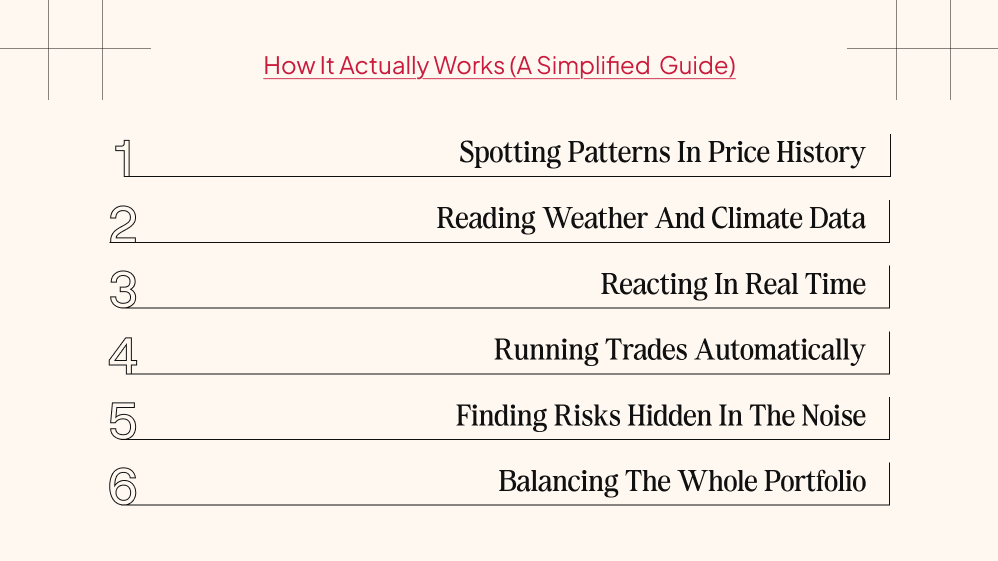
Let’s open the hood and look at what these systems actually do, without the marketing fluff. This is really the heart of revolutionizing commodities trading with AI: turning an overwhelming pile of numbers into something a person can act on in seconds.
1. Spotting Patterns In Price History
Take one of the most basic building blocks in any market model: the Simple Moving Average (SMA).
Rather than staring at a jagged, chaotic price chart, you just total up closing prices across a set window of days. Say, the last twenty and divide by that same number of days.
The resulting line strips out afternoon spikes and panics to show where the underlying trend is actually pointing.
Where modern software departs from a basic chart platform is scale. Instead of evaluating a single smoothed line in isolation, machine learning engines stack thousands of these baseline calculations against each other.
They map those price trends directly alongside satellite cloud cover, port congestion reports, and historical price shocks. The end result isn’t a magical crystal ball. But it gives you a vastly clearer picture than relying on a standalone average.
SMA = (P1 + P2 + P3 + … + Pn) ÷ n
2. Reading Weather And Climate Data
A frost in Brazil can send coffee prices climbing within hours.
To clarify, the AI tools scan satellite imagery and weather models around the clock, translating rainfall and temperature patterns into estimates of how much of a crop will actually make it to market.
3. Reacting In Real Time
Your financial habits can improve with AI’s interpretation.
Where a human trader might need thirty minutes to digest a news report, AI systems can process it in seconds and flag whether it matters for a given position.
4. Running Trades Automatically
Some systems are set up to place trades on their own once certain conditions are met, cutting out the delay and the emotional decision-making that often leads to costly mistakes.
5. Finding Risks Hidden In The Noise
AI can notice a link between, say, currency movements and grain shipments that a person might never think to compare.
For a bootstrapping startup, it is even more important to keep costs lean and revenue agile. That’s where a lot of the value quietly sits.
6. Balancing The Whole Portfolio
Instead of looking at one trade at a time, AI can weigh dozens of positions together and suggest a mix that reduces overall risk.
Here’s a side-by-side of how this shift actually looks in practice:
| Task | Traditional Approach | AI-Powered Approach |
| Reading market news | Analyst reads reports manually | Software scans thousands of sources in seconds |
| Forecasting demand | Based on monthly reports and experience | Based on live data updated continuously |
| Weather impact analysis | Rough estimates from public forecasts | Satellite and climate models cross-checked automatically |
| Risk detection | Found after the fact, often too late | Flagged in real time before losses grow |
| Trade execution | Manual, with a delay | Automated within pre-set rules |
What You Actually Gain From This?
The benefits of revolutionizing commodities trading with AI aren’t abstract, and they don’t take years to show up. Most trading desks notice a difference within a single season. They show up in three concrete ways:
- Sharper accuracy. Forecasts get better when they’re built on more data points, not fewer.
- Less wasted time. Traders spend less time digging through spreadsheets and more time making calls that matter.
- A real edge over slower competitors. In a market where minutes matter, being first to notice a shift is often the whole game.
The Risks Nobody Likes To Mention
No honest article on this topic would skip the downsides, so here they are.
AI is only as good as the data it’s fed. Feed it messy or incomplete numbers, and it will confidently produce a wrong answer, and it won’t necessarily tell you it’s unsure.
Setting these systems up isn’t cheap either; it takes investment in technology and in people who know how to run it. Again, that can be a real hurdle for a smaller trading desk.
And as regulators start paying closer attention to automated trading, firms will need to stay transparent about how their AI tools actually make decisions. Not just what those decisions were.
None of this is a reason to avoid revolutionizing commodities trading with AI altogether. Rather, I would only recommend:
- Keeping your eyes open
- Testing new tools on smaller positions first, and
- Keeping a human in the loop for the calls that really matter.
What This Means Going Into 2026 And Beyond
As these tools become cheaper and easier to use, smaller trading firms are getting access to technology that used to belong only to giant institutions. Two trends worth watching:
Satellite and sensor data getting cheaper. Combining AI with real-time images of ports, farms, and factories gives traders a live view of the physical world behind every contract.
Blockchain adding transparency. Pairing AI’s forecasting power with blockchain’s tamper-proof record-keeping could make it far easier to trust where a commodity actually came from.
Frequently Asked Questions (FAQs):
No. It’s handling the grunt work of scanning data, so traders can spend their time on judgment calls and strategy, the parts machines still can’t do well.
Yes, and this is one of the more exciting shifts happening right now. As tools get more affordable, AI-driven commodities trading is no longer limited to firms with massive budgets.
AI might be tracking the wrong data or pulling together information from several sources that don’t add up to the real picture. Therefore, if you train your AI based on an inappropriate database, it will deliver wrong or poor interpretation results.
Not anymore. You can easily design a simple dashboard with AI. Meanwhile, people with or without coding knowledge and a sense of design aesthetics can easily use the tools.
Actual Takeaways For 2026
You don’t need to learn quantitative programming overnight. Honestly, you don’t need to learn it at all.
The real priority is simply keeping your head up and seeing where the desk is moving. Look at who’s winning right now.
For clarification, take a look at the traders who spent the last couple of years experimenting with these platforms and are entering 2026 with a real leg up.
The whole point of revolutionizing commodities trading with AI isn’t to push humans out of the room. It’s to feed your instinct better, cleaner inputs. Start slow.
Let the software sift through the endless noise so you can save your focus for the calls that actually require human discretion.
Disclaimer: The purpose of this article is to increase general awareness. We are not offering exact financial advisory or roadmap. However, our denominations are true to concepts and common market equations. Commodities trading carries real financial risk, and anyone considering it should speak with a licensed financial advisor before making decisions.


Must Read

Is Bankruptcy Right for You? Questions to Ask Before Filing in Georgia

How to Build a Modern Business Protection Strategy

Popular Street Bikes for Everyday Commuting

Head Of Growth Marketing Responsibilities: A Beginner’s Guide To The Role

How To Build A Growth Marketing Strategy That Actually Works
Most Popular

A Guide For Deductibles and Premiums in Accident Insurance
Financial Survival Tips for Entrepreneurs in Debt
Toronto Car Insurance vs. Other Cities: Why Are Rates So High?

The Future of MENA Businesses: Why You Need Both Management & Accounting Software




Leave A Reply