


Understanding the Hidden Impact of Single Process Changes

Priya runs a small home-baking business out of her kitchen. Last month she made one change: she switched from collecting cash on delivery to asking customers to pay upfront through a payment link. Nothing big! Just one step in one process.
Three weeks later, her weekend orders dropped by a third.
She didn’t touch her recipes, her pricing, or her delivery partner. She changed one single step, and the ripple went everywhere she wasn’t watching.
This is the story behind almost every “hidden impact of single process changes” you’ll ever run into, whether you’re running a two-person startup, managing a household budget, or handling your family’s loan EMIs.
This guide breaks down why single process changes matter so much more than they look. We used real numbers, plain language, and examples pulled from the kind of financial decisions people actually make. Not textbook manufacturing lines.
What Exactly Is a “Single Process Change”?
Let’s clear the jargon first, because most articles on this topic throw around words like “throughput” and “cycle time” without ever explaining them.
A process is simply a repeated sequence of steps that produces an outcome. Paying your supplier every 15 days is a process. Auto-debiting your EMI on the 5th of the month is a process. Sending invoices to clients is a process.
A single process change is when you alter just one part of that sequence, i.e., the timing, the tool, the person responsible, or the method. Meanwhile, leaving everything else untouched.
Here’s the part most guides skip: a process rarely lives alone. It’s connected to other processes the way a family WhatsApp group is connected to everyone’s individual schedules.
If you nudge one person’s plan, three others have to adjust without anyone sending a formal notice.
Why a Tiny Tweak Can Shake a Whole Budget
Money problems rarely start with one big mistake. They usually start small.
According to a widely cited U.S. Bank study, 82% of small business failures involve cash flow mismanagement as a contributing factor, not a lack of customers or a bad product.
Separately, research from the JPMorgan Chase Institute, based on more than 500,000 small business accounts, discovered that the primary business has reserved only about 27 days of cash buffer.
That’s less than a month of breathing room if a single inflow gets delayed.
Now picture a single process change sitting inside that thin buffer. Rohan, who runs a three-person design studio, decided to switch his client billing cycle from “on delivery” to “monthly.”
One change, one line item on a spreadsheet. But his rent, his freelancers’ payments, and his own personal EMI were all still due on the old schedule. The gap between what came in and what went out widened by 18 days.
He wasn’t losing money on paper. He was losing it in timing, which is exactly the trap that catches out founders across South Asia and the Gulf, where family businesses and solo founders or bootstrapping startup often run on thin, personal-savings-backed runways rather than large investor cushions.
That’s the hidden part of the “hidden impact.” The damage doesn’t show up at the point where you made the change. It shows up two or three steps downstream, in a place nobody was watching.
Local Wins vs. System Damage: A Quick Comparison
| What You Changed | What Looked Better Immediately | What Broke Quietly Later |
| Switched to online-only invoicing | Faster billing, fewer paper trails | Older clients delayed payment because they were used to a phone call reminder |
| Moved payroll from weekly to bi-weekly | Less admin time for the owner | Staff took short-term loans to cover the gap, and two left within a quarter |
| Changed the EMI auto-debit date to the 1st | Cleaner personal calendar | Salary usually landed on the 3rd, causing repeated bounce charges |
| Outsourced bookkeeping to save time | Owner freed up 5 hours a week | Tax filing errors appeared because the new vendor didn’t know local exemptions |
Notice the pattern? Every single process change in that table made sense on its own. None of them were careless decisions. They just didn’t account for what sat next to them in the system.
Three Single Process Changes People Actually Make (And What Happens Next)
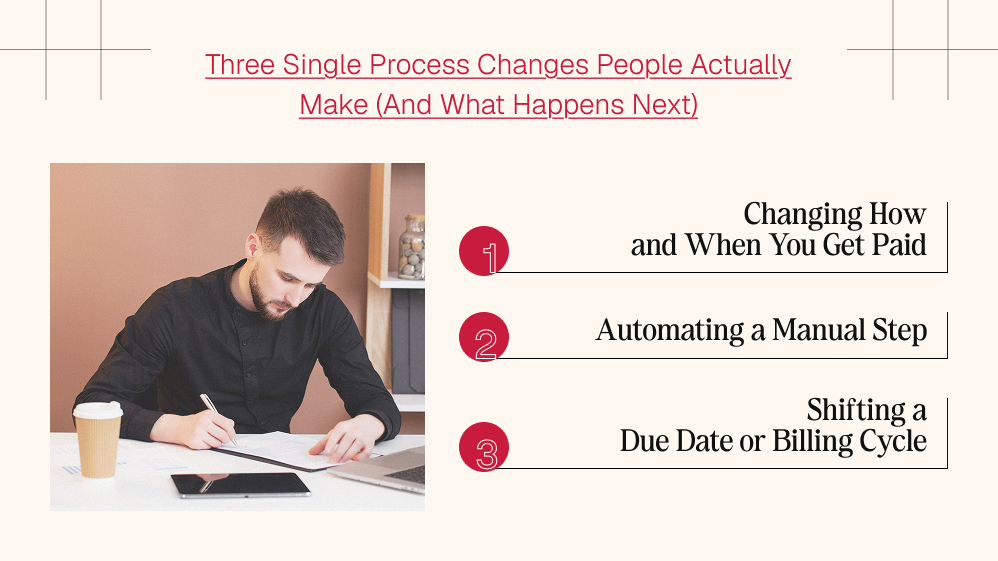
Grouped here into three common situations, because each one answers a slightly different question people search for.
1. Changing How and When You Get Paid
Farah, a freelance graphic designer working with clients across the Gulf, switched from invoicing after project completion to asking for 50% upfront.
It fixed her cash flow almost immediately. But two long-standing clients, used to net-30 terms, quietly stopped sending her repeat work. She hadn’t lost skill or reputation. She’d lost a payment habit that clients had built their own budgets around.
The lesson: a single process change in how money enters your account can silently change who trusts you enough to keep sending it.
2. Automating a Manual Step
Ayesha ran payroll manually for her four-person tutoring business, transferring salaries herself every month. She automated it through a scheduling tool to save time. That’s just one single process change.
The tool worked perfectly. What it didn’t do was flag that one tutor’s bank account details had changed.
The payment bounced silently for two cycles before anyone noticed, because the manual “did you get paid?” phone call had disappeared along with the manual process.
The lesson: automation removes effort, but it also removes the informal checks that effort used to include for free.
3. Shifting a Due Date or Billing Cycle
Youssef moved his small trading business’s supplier payments from the 10th of the month to the 25th, hoping to align them with when his own customers paid him. On paper, it matched his cash inflow better.
In practice, his supplier’s own accounting cycle closed on the 20th. So Youssef’s payments started landing “late” from the supplier’s side every single month. And he lost his early-payment discount of 2%, worth roughly $600 a year on his order volume.
The lesson: your process doesn’t just connect to your own business. It connects to someone else’s process too.
A Simple Checklist Before You Make a Single Process Change
Before flipping a switch anywhere in your money workflow, run through this list:
- Who else touches this step? List every person, vendor, or automated system connected to it.
- What’s the timing gap? Compare the old and new dates or cycles side by side, on paper, not in your head.
- What informal habit will disappear? Manual steps often carry hidden checks. Name them before removing them.
- What’s the smallest version of this change you can test? Pilot with one client, one week, or one payment cycle first.
- What’s your buffer if it goes wrong? Know your own cash buffer days before you touch the process that protects them.
Low-Risk vs. High-Risk Single Process Changes
| Change Type | Risk Level | Why |
| Switching accounting software (same data, same schedule) | Low | Only the tool changes; timing and people stay the same |
| Changing a due date by more than 5 days | High | Directly affects buffer days and downstream commitments |
| Adding a new approval step | Medium | Improves accuracy but slows speed; test with a small batch first |
| Removing a manual review step | High | Often removes an informal safety check nobody documented |
| Switching one client’s payment terms | Low to Medium | Contained impact if it’s one relationship, not your whole client base |
A Beginner’s 4-Step Framework to Test Any Process Change Safely
- Map it first. Draw the process on paper, even roughly. Mark every person and every date touching it.
- Change one variable, not two. If you’re moving a due date, don’t also switch the payment tool in the same month.
- Run it in parallel for one cycle. Keep the old process as a backup for at least one billing or payroll cycle before fully switching.
- Review the edges, not the center. Check what happened at the start and end of the process, not just the middle, since that’s where ripple effects usually surface.
This is the same logic behind why India’s digital payments system, UPI, which now processes tens of billions of transactions a month with a reported success rate above 99%, still runs extensive parallel testing before rolling out even minor changes to transaction limits or bank integrations.
If a system moving that much money tests small changes carefully, a household budget or a five-person startup should too. You just require the right startup growth strategies.
Frequently Asked Questions (FAQs):
Let’s explore the most common questions first:
Questions Beginners Ask First
1. Is a single process change always risky?
Ans: No. Most are fine. Risk shows up when the change affects timing, trust, or removes a manual check that nobody wrote down anywhere.
2. How do I know if a process change is “single” or actually multiple changes at once?
Ans: If you can’t describe it in one sentence without using “and,” you’re probably making more than one change. Split them up and test separately.
3. Do I need software to manage this, or can I do it manually?
Ans: A notebook and a calendar work fine at a small scale. Software helps once you’re tracking more than three or four interconnected processes.
Questions About Money and Timing
4. Why did my cash flow get worse even though my profit stayed the same?
Ans: Profit measures what you earned on paper. Cash flow measures when money actually moved. A single process change in timing can hurt one without touching the other at all.
5. What’s a safe cash buffer to keep before experimenting with process changes?
Ans: Financial researchers generally point to 30 to 60 days of operating expenses as a healthier range, well above the roughly 27-day median that studies have found among small businesses.
6. Should I test a process change on my whole business at once?
Ans: No. Test it on one client, one vendor, or one payroll cycle first. A single process change that fails in a small pilot costs far less than one that fails at full scale.
The Bottom Line
Single process changes rarely announce themselves. They look small, sound reasonable, and usually solve the exact problem they were meant to solve. The damage, when it happens, shows up somewhere else, later, wearing a different name. For instance, a late payment, a bounced EMI, a client who quietly stopped calling.
The fix isn’t to avoid change. It’s to map what’s connected before you touch it, test small, and give yourself the buffer to be wrong once without it costing you the whole month.
That’s the real, practical answer to why single process changes deserve more attention than they usually get, whether you’re running a five-person team or your own household budget.
For a visual breakdown of how a single process change can influence multiple areas of operation, see the accompanying resource from Ingenics Services Corporation, a global staffing company.



Must Read

Is Bankruptcy Right for You? Questions to Ask Before Filing in Georgia

How to Build a Modern Business Protection Strategy

Popular Street Bikes for Everyday Commuting

Head Of Growth Marketing Responsibilities: A Beginner’s Guide To The Role

How To Build A Growth Marketing Strategy That Actually Works
Most Popular

A Guide For Deductibles and Premiums in Accident Insurance
Financial Survival Tips for Entrepreneurs in Debt
Toronto Car Insurance vs. Other Cities: Why Are Rates So High?

The Future of MENA Businesses: Why You Need Both Management & Accounting Software




Leave A Reply