


Why A Free SEO Competitor Analysis Tool Is A Beginner’s Ultimate Cash Machine

I remember the exact night the wheels fell off. It was 2:00 AM on a Tuesday. I was sitting at my kitchen table, staring at a blank Google Doc, completely exhausted.
I had spent the last three weeks writing a massive, 4,000-word guide on personal budgeting for my new site, emblemwealth.com. Above all, I poured my soul into it. I hit publish, closed my laptop, and waited for the cash to start rolling in.
Nothing happened. For two whole months, my total visitor count was exactly four people. Two of them were my mom.
I felt like an absolute failure. I was doing everything the online gurus told me to do. At the same time, I was writing “high-quality content.” I was posting consistently. Yet, my traffic was a flat, depressing zero line. I was yet to know the potential of an seo competitor analysis tool.
My Real Life Scenario!
Then I met Sarah at a local business meetup. Sarah was a college dropout quietly earning $6,000 a month from a tiny blog about pet care. I asked her what her secret was. She laughed, pulled out her phone, and opened a basic software dashboard.
“Your problem is that you are guessing,” she said. “You are writing things you think are interesting. I only write things that I already know are making my competitors rich.”
That conversation changed everything for me. It was my introduction to using an seo competitor analysis tool. You see, when you are a complete beginner with no formal business background.
You are trying to guess what people are searching for online is a financial death sentence. To sum up, you do not have the budget to fail for a year. You need a shortcut.
Using an seo competitor analysis tool isn’t about being a coding genius or a math wizard. It is simply about looking over the shoulders of people who are already winning, finding the exact gaps they forgot to lock up, and stepping right through the front door.
The Big Awakening: Slipping Past The Gatekeepers

Let us look at the real-world battlefield. When you launch a website about money, building wealth, or personal finance, you are competing against massive, multi-million dollar corporate media empires. They have rooms full of paid writers, massive tech budgets, and years of head start.
If you try to write a general article about “how to save money,” you are going to get completely obliterated. You will be buried on page 45 of the search results where nobody will ever find you.
But those giant corporate sites have a fatal flaw. They are too big to care about the little things. They focus entirely on massive, high-volume topics. Meanwhile, they write generic articles for the masses.
This is exactly where an seo competitor analysis tool becomes your ultimate equalizer.
When you plug a mid-sized competitor’s web address into an seo competitor analysis tool, you get to see their private ledger. You can see a complete list of the weird, specific phrases driving clicks to their site. Meanwhile, you aren’t looking for their biggest articles. You are hunting for their accidental wins.
For example, when I finally ran a competitor through a software dashboard, I found a tiny, independent blog ranking number one for the phrase: “how to budget as a traveling nurse under thirty.”
The article was short, poorly formatted, and hadn’t been updated in three years. Yet, it was bringing in 400 highly targeted readers every month. The big corporate sites didn’t care about this phrase because it was too specific.
But for a small site like emblemwealth.com, that is a goldmine. I wrote a detailed, beautiful guide specifically for traveling nurses, added a free Excel tracking sheet, and took over the top spot in less than three weeks.
Breaking Down the Real Numbers: The Truth About SEO ROI
Let’s talk about cold, hard cash. Most beginners jump straight into paid advertising because they want to see traffic indicators move immediately. They run to Facebook or Google Ads, dump $200 into a campaign, and watch their dashboard light up.
But here is the trap. Paid traffic is a drug. The absolute second you stop feeding money into the machine, your traffic drops to zero. You own nothing.
When you invest your time into organic search, you are building actual digital real estate. You are buying an asset that continues to pay dividends. Let us look at how you actually calculate your true seo roi so you can see why this matters.
Imagine you decide to stop guessing. You invest $100 into a solid keyword research platform, or you find a highly accurate free trial of an seo competitor analysis tool. You use it to find three low-competition search phrases that your direct competitors are making money from.
Now, you write those three articles. To speed up the process, you spend another $100 on a manual outreach helper to do some high-quality guest posting for seo. This gives your new pages the authority they need to climb the rankings.
Your Total Investment Looks Like This:
| Expense Item | Real Cost |
| Core Research Software | $100 |
| Targeted Outreach Link | $100 |
| Total Startup Capital | $200 |
Now, let us watch the money flow in over the next twelve months. Because you used real data instead of guesswork, all three of your articles hit the first page of Google. Combined, they bring in a modest 1,000 visitors per month to your site.
You aren’t trying to sell them a high-ticket, complicated product. You simply have a helpful review of a $30 digital budget planner. Therefore, you get a $15 commission every time someone signs up through your link.
If only 2% of those 1,000 monthly visitors buy the planner, that is 20 sales.
20 Sales × $15 Commission = $300 Per Month
Over the course of a single year, that one small cluster of articles brings in a total income stream:
$300 × 12 Months = $3,600
Let us run the formal calculation to find your true seo roi:
                 Net Profit = $3,600 − $200 = $3,400
                 SEO ROI = ($3,400 / $200) × 100 = 1,700%
You spent $200 once. The traffic keeps coming every day while you sleep, hike, or hang out with your kids. That is how real digital wealth is built on a shoe-string budget.
Where the Money Lives: How Popular vs. Underrated Platforms Pay Out
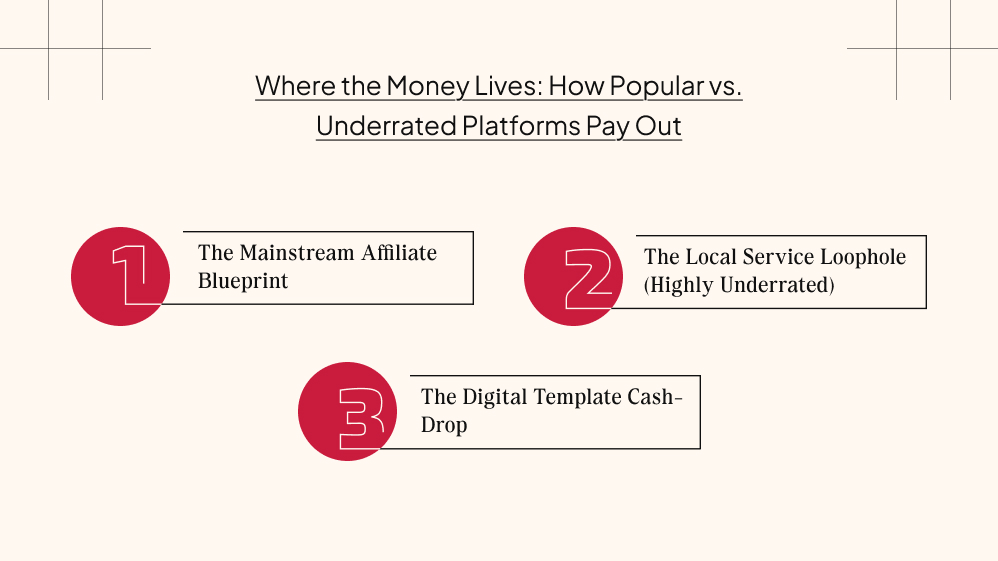
Once you have the traffic coming in via your competitive intelligence, you need to know how to turn those eyeballs into cash. Different platforms require completely different strategies. Let us pull back the curtain on how the cash actually moves.
1. The Mainstream Affiliate Blueprint
- The Blueprint: You find a competitor that ranks highly for comparison keywords such as “Brand A vs. Brand B software.”
- You use your seo competitor analysis tool to verify that people are actively searching for this comparison. You write an honest, unbiased breakdown. After that, you include your custom affiliate tracking links for both products.
- The Million-Dollar Error: Most beginners make the mistake of writing a fake, overly glowing review because they want the commission. They sound like a late-night TV commercial.
- Modern readers can spot a fake review in two seconds. If a product has a terrible user interface or an annoying cancellation policy, say so.
- When you protect your reader from a bad purchase, they will trust your recommendations forever.
2. The Local Service Loophole (Highly Underrated)
- The Blueprint: Don’t look at national brands. Use your research process to look into local businesses in mid-sized cities, such as independent financial planners, bookkeeping services, or real estate coaches. Look at what questions their local clients are searching for online.
- How to Profit: Write a localized guide answering that specific question. Reach out to three local professionals in that city and say, “Hey, I have an article ranking number one for this local search phrase.
- It gets 150 local clicks a month. Do you want me to route these leads directly to your office phone for $100 a month?” Two out of three times, they will say yes. It is pure, passive cash flow from a tiny pocket of traffic.
3. The Digital Template Cash-Drop
- The Blueprint: Find out what free resources your successful competitors are offering to build their email list. Are they giving away a printable checklist? A simple spreadsheet? A PDF guide?
- How to Profit: Build a version that is slightly cleaner, more modern, and easier to use on a mobile phone. Give it away for free on your site to build a community newsletter list.
- Once you have 500 people on that list, find a premium, highly detailed software tool or masterclass that solves their next major problem.
- Partner with the creator for a 50% revenue split. You don’t have to build anything yourself. You are just matching an audience you understand with a tool they desperately need.
Three Lethal Mistakes That Cause New Bloggers to Quit

I have watched dozens of smart, hardworking people launch blogs and give up within their first ninety days. They don’t quit because they are lazy. They quit because they run face-first into these three invisible brick walls.
1. The Vanity Traffic Chase
When beginners first open an analytical dashboard, their eyes go straight to the biggest numbers. They see a keyword that gets 80,000 searches a month and get starry-eyed. They spend weeks trying to target it.
What they don’t see is the hidden metric: Keyword Difficulty. High-volume terms are heavily guarded by corporate giants. You are basically a kid on a bicycle trying to drag-race a Ferrari. Save your sanity.
Target the tiny keywords that get 300 searches a month. If you stack ten of those together, you have 3,000 highly profitable visitors that nobody else is fighting you for.
2. The AI-Generated Content Dump
With the rise of automated writing tools, beginners think they can just click a button, generate fifty generic articles, and rank overnight. This is an absolute illusion. Search engines have highly sophisticated automated spam filters designed to catch and bury low-effort, repetitive machine text.
If your article reads like a boring high school textbook, humans will bounce immediately, and Google will drop your rankings into the abyss. Write like a real person. Share your mistakes. Tell stories.
3. The Great Abandonment
Paid advertising gives you data in five seconds. Organic search engine marketing is a slow, heavy flywheel.
When you publish a post or finish a round of guest posting for seo, it can take four to eight weeks for search engine crawlers to map your links, calculate the context, and move your position up the ladder.
Most beginners publish an article, check their traffic forty-eight hours later, see a zero, and decide the system is broken. They walk away right before the gears actually click into place. You have to give your site room to breathe.
Your Step-by-Step Action Blueprint For This Week
If you want to stop spinning your wheels and start building an actual digital asset that makes money, follow this exact sequence starting tomorrow morning:
- Find Your Three Mirrors: Identify three independent creators in your niche who are clearly making money but aren’t massive media giants. Look for sites run by single individuals or small teams.
- Audit the Gaps: Use your research tools to find their top five highest-traffic pages. Look specifically for topics where their articles are short, outdated, or lacking clear visual guides.
- Build the Superior Asset: Write a version for your own site that is cleanly formatted, uses short, scannable paragraphs, and includes real-world, actionable steps. Make it impossible for a reader to walk away without an answer.
- Secure the Groundwork: Pick your single best piece of content and focus on getting two or three high-quality, authentic contextual links pointing to it from other real blogs in your neighborhood.
Building a profitable digital asset isn’t about chasing a magical, overnight secret code. It is about avoiding obvious automated traps, using real data to eliminate guesswork, and focusing entirely on delivering clear, human value to real people who are looking for real answers.


Must Read

How to Build a Modern Business Protection Strategy

Popular Street Bikes for Everyday Commuting

Head Of Growth Marketing Responsibilities: A Beginner’s Guide To The Role

How To Build A Growth Marketing Strategy That Actually Works

Growth Marketing For Beginners: A Simple Way To Grow Your Small Business
Most Popular

A Guide For Deductibles and Premiums in Accident Insurance
Financial Survival Tips for Entrepreneurs in Debt
Toronto Car Insurance vs. Other Cities: Why Are Rates So High?

The Future of MENA Businesses: Why You Need Both Management & Accounting Software


Leave A Reply