


How to Build a Bootstrapped Startup Financial Model That Actually Saves Your Business
We see it everywhere on social media. A tech founder posts a sleek, multi-colored graph showing a straight line pointing directly up and to the right.
They tell you it is easy. Moreover, they talk about pre-seed funding, venture capital backing, and scaling to seven figures in six months.
But what if you do not have investors?
What if your current office is a cluttered kitchen table, your funding is just the leftover balance from your last paycheck, and your team is just you and a lukewarm cup of coffee?
When you build a business from scratch with nothing but your own savings, standard financial advice stops working.
You cannot rely on academic formulas or template spreadsheets downloaded from venture capital blogs. You need to understand how money actually moves through a raw, unbacked company.
Let us pull back the curtain on how startup booted financial modeling strategy actually works in the real world.
We will look at the exact mistakes that sink most early founders, walk through a realistic example of how a tiny company manages its cash flow, and show you how to build a model that keeps your business alive.
What Is A Startup Financial Model?
Definition: A startup financial model is a structured spreadsheet that estimates your future revenue, expenses, cash flow, and overall profitability based on realistic business assumptions.

Unlike investor-focused models, a startup booted financial modeling focuses primarily on maintaining positive cash flow and reaching a clear break-even point without relying on external capital injections.
When you do not have a venture capital cushion, your startup financial planning must be exceptionally precise. You cannot afford to guess. Your model serves as your operational dashboard, warning you of upcoming cash shortages long before they happen.
How We Developed This Framework
The guidelines in this article are not pulled from corporate textbooks. Instead, we developed this operational framework at emblemwealth.com by merging traditional corporate finance fundamentals with lean startup budgeting, real-world cash flow management practices, and lessons learned from operating self-funded digital businesses.
Our approach strips away the bloated assumptions used to pitch angel investors. Instead, it replaces them with ground-level startup forecasting techniques designed to protect your personal capital and maximize every dollar of organic revenue.
Traditional VS. Bootstrapped Models
| Traditional Investor Approach | Startup Booted Financial Modeling Approach |
| Driven by valuation, vanity metrics, and user acquisition speed. | Driven by actual cash flow, unit economics, and immediate survival. |
| Accepts high monthly cash burn to aggressively capture market share. | Focuses heavily on reaching organic break-even points quickly. |
| Uses top-down market assumptions (e.g., “We will capture 1% of a $10B market”). | Uses bottom-up numbers grounded in real traffic and historical conversion rates. |
What Does A Startup Financial Model Include?
Comprehensive startup booted financial modeling is more than a simple list of your monthly bills. To give you true financial control, your financial planning spreadsheet needs to link several interconnected core sections together.
Core Modules Of A Bootstrapped Financial Model
- Assumptions Sheet: The control center where you list your conversion rates, pricing tiers, and traffic growth metrics.
- Revenue Forecast: A detailed layout of how your marketing channels translate into paid transactions or subscriptions.
- Expense Forecast: A granular breakdown separating your fixed overhead from your variable operational costs.
- The Big Three Financial Statements: Your integrated Income Statement, Cash Flow Statement, and Balance Sheet.
- Key Metrics Dashboard: A visual dashboard that highlights your cash runway, burn rate, and break-even timelines.
Financial Statements Explained For Beginners

To build a reliable startup financial forecast, you do not need an accounting degree. However, you do need to understand how the three classic startup financial statements interact.
1. The Income Statement (Profit & Loss)
Definition: An Income Statement (also known as a P&L) measures your business’s revenues and expenses over a specific period to calculate your net profit.
It tells you whether startup booted financial modeling is fundamentally profitable on paper, though it does not reflect the exact timing of your cash collections.
2. The Cash Flow Statement
Definition: A Cash Flow Statement tracks the actual movement of cash into and out of your bank account during the month.
For a self-funded founder, this is the most critical document because it highlights exactly when cash leaves your hands versus when it is cleared and usable.
3. The Balance Sheet
Definition: A Balance Sheet provides a snapshot of your company’s financial position at a single point in time.
It details your assets (what your business owns, such as laptops or bank balances), your liabilities (what your business owes, such as credit card debts), and your equity.
How The Three Statements Connect
| Statement | Primary Question It Answers | Key Metric Found Here |
| Income Statement | Is this business operation fundamentally profitable on paper? | Gross Margin & Net Profit |
| Cash Flow Statement | Do we have enough real money in the bank to pay our bills next Tuesday? | Net Cash Flow & Ending Cash |
| Balance Sheet | What is the overall net worth of the business infrastructure today? | Cash Capital & Liabilities |
Essential Startup Metrics Every Founder Should Track

To run an effective startup budgeting process, you must move past vanity metrics like social media followers or raw page views. You need to monitor the underlying operational metrics that drive your growth.
Core Financial Formulas
Gross Margin % = ((Revenue − COGS) / Revenue) × 100
Monthly Burn Rate = Monthly Cash Inflows − Monthly Cash Outflows
Cash Runway (Months) = Total Available Cash Balance / Absolute Monthly Burn Rate
Key Metric Glossary
- Monthly Recurring Revenue (MRR): The predictable total revenue your business expects to receive each month from active subscriptions.
- Annual Recurring Revenue (ARR): Your MRR multiplied by 12, showing your annualized subscription run rate.
- Customer Acquisition Cost (CAC): The total marketing and sales cash spent to acquire a single new paying customer.
- Customer Lifetime Value (LTV): The total net revenue a single customer generates for your business before they cancel or stop buying.
- Churn Rate: The percentage of your customer base that cancels their services or subscriptions within a given month.
- Customer Payback Period: The number of months it takes for a customer to generate enough revenue to fully pay back the cost of acquiring them.
Startup Financial Model Template Structure
When setting up your financial model template in Google Sheets or Excel, keep your workspace clean. We recommend separating your architecture into five distinct tabs to keep your logic clear.
| Tab Name | Operational Purpose | Key Variables Contained Inside |
| 1. Assumptions | The central control panel for your entire business model. | Traffic numbers, conversion rates, price points, and refund rates. |
| 2. Growth & Revenue | Calculate your monthly customer additions and startup revenue projections. | Active customer pools, upgrades, expansion revenue, churned accounts. |
| 3. Operating Expenses | Maps out all cash leaving the business to keep things running. | Hosting, startup operating expenses, SaaS tools, contractor fees. |
| 4. Cash Flow Forecast | Houses your actual startup cash flow forecast and bank balance tracking. | Cash collections, tax allocations, true closing bank balances. |
| 5. Dashboard | Turns your raw rows of numbers into clean visual indicators. | Runway alerts, break-even charts, burn rate trends. |
Example Startup Financial Model: 6-Month Projection
Let us look at a realistic, bottom-up startup cash flow model example for a bootstrapped digital product company over its first six months of operation.
| Metric | Month 1 | Month 2 | Month 3 | Month 4 | Month 5 | Month 6 |
| Starting Cash | $5,000 | $4,100 | $3,650 | $4,150 | $5,050 | $6,700 |
| Gross Revenue | $200 | $800 | $1,800 | $2,500 | $3,500 | $4,800 |
| Cost of Goods Sold (COGS) | $50 | $100 | $150 | $200 | $300 | $400 |
| Operating Expenses (OpEx) | $1,050 | $1,150 | $1,150 | $1,400 | $1,550 | $1,750 |
| Net Cash Flow | -$900 | -$450 | +$500 | +$900 | +$1,650 | +$2,650 |
| Ending Cash Balance | $4,100 | $3,650 | $4,150 | $5,050 | $6,700 | $9,350 |
Reality Check: Notice that in Months 1 and 2, the business runs a negative net cash flow. This is your active startup burn rate.
Because the founder built a clear model, they knew their initial $5,000 savings pool could easily absorb these early losses until the business reached its startup break-even analysis target in Month 3.
Which Businesses Need Bootstrapped Financial Modeling?
Any founder who lacks an outside safety net needs to use a cash-focused modeling approach. However, different business styles face distinct operational cash challenges.
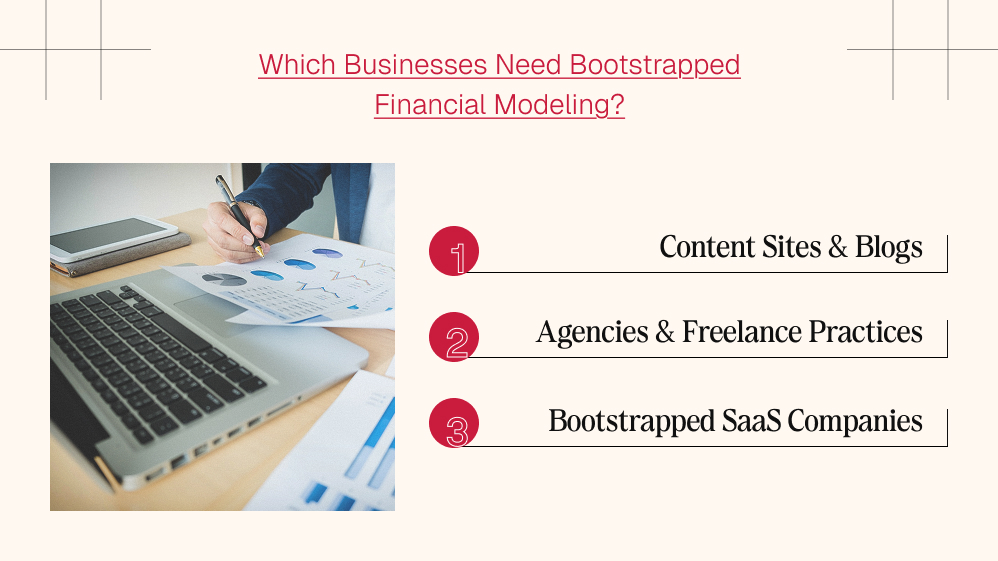
- Content Sites & Blogs: These businesses have low initial overhead but experience long monetization delays. They must model their cash flow to survive the six- to twelve-month gap before display ad networks and affiliate programs pay out.
- Agencies & Freelance Practices: Agencies deal with lumpy cash flows caused by client payment terms. They require startup booted financial modeling to prevent them from hiring contractors before client deposits actually clear the bank.
- Bootstrapped SaaS Companies: Software setups have high early development costs followed by highly predictable recurring revenue. They must monitor their payback periods closely to ensure their cash reserves can fund user acquisition costs.
The Blind Spots: Why Most New Founders Get It Wrong
When we analyze early business growth patterns, we notice a clear trend. Most founders who start an online business run into a massive wall within their first twelve months.
It is rarely because their product is bad. It is almost always because they treated their bank account like a personal wallet instead of a dynamic machine.
Assumptions You Should Never Ignore
To build a bulletproof model, you must account for the hidden friction points that disrupt normal business operations:
- Late Payments & Invoicing Delays: Corporate clients routinely delay invoice processing by 45 to 60 days.
- Refund Rates & Chargebacks: At least 2% to 5% of digital sales will result in product refunds or payment disputes.
- Software Inflation: Free software tiers expire quickly as your customer base grows, leading to sudden price spikes.
- Tax Allocations: Governments collect taxes on your net profits, meaning 25% to 30% of your earnings do not belong to you.
Real Life Breakdown: The Story Of Sarah’s Growth Challenges
To see how a true startup financial model functions, let us walk through a practical scenario based on the exact challenges real founders face every morning.
Meet Sarah. She spent four years working as a content manager for a tech firm before quitting to start her own independent B2B digital agency.
She did not have a wealthy co-founder or a line of credit from a bank. In fact, she had exactly $8,000 in personal savings to give her business a runway.
In her first month, Sarah landed two solid clients. Each agreed to pay her $1,500 a month for recurring content strategy. On paper, things looked fantastic.
She was making $3,000 a month while working from her living room. She felt like an absolute genius. Then, reality hit her like a bucket of ice water in month two.
One of her clients had a complex accounting department. They processed invoices on a strict 45-day delay.
Sarah sent her invoice on November 1st, but the money would not arrive until mid-December. Meanwhile, her second client ran into a sudden budget cut and paused their contract without warning.
Suddenly, Sarah’s expected $3,000 dropped to zero in cash collected for November. Yet, her software bills, internet connection, and rent were still due on the first of the month.
Because she lacked a proper cash-flow forecasting framework, she could not see this dry spell coming. She had calculated her business health based on earned income rather than on cash collected.
How Sarah Solved The Problem
Sarah survived by pivoting her entire approach to finance. She stopped using complex accounting terms and built a simple tracker based on a single core rule: Cash is reality; everything else is just an opinion.
- She shifted her clients to a mandatory 50% upfront deposit before starting any project.
- After that, she cut out every single nonessential software tool, moving back to free options until her baseline income stabilized.
- Lastly, she built a rolling three-month cash projection to ensure she always knew exactly how much money would be in her bank account twelve weeks from today.
By using a strict, bottom-up modeling approach tailored for tiny operations, she kept her business alive through three separate client departures the following year. She did not need an MBA. She just needed a clear view of her cash timeline.
10 Common Financial Modeling Mistakes To Avoid
- Mixing Profit with Cash: Assuming that a high paper profit on your Income Statement means you have liquid cash available to spend right now.
- Ignoring Taxes: Failing to set aside quarterly tax reserves, leaving you exposed to major financial penalties at the end of the year.
- Unrealistic Growth Curves: Planning for a perfect, linear 15% month-over-month increase in traffic without accounting for seasonal market drops.
- Forgetting Software Renewals: Overlooking the cost of automated annual subscriptions that quietly auto-renew and drain your bank account.
- Underestimating Customer Acquisition Costs: Assuming you can get endless free organic traffic without spending cash on paid experiments.
- Forgetting Owner Salary: Failing to build a sustainable personal living wage into your baseline operating expenses.
- Ignoring Seasonality: Assuming your peak November sales volume will carry into the traditionally slow summer months of July and August.
- Not Updating Assumptions: Building a spreadsheet model once and letting it sit idle instead of updating it with actual monthly data.
- Copying Investor Templates: Using institutional templates that prioritise venture capital growth milestones over cash-flow survival.
- Forecasting Yearly Instead of Monthly: Mapping out your financial plans in broad annual blocks, which masks deep monthly cash deficits.
Free Tools You Can Use
You do not need to buy expensive corporate performance management software to manage your startup finance tasks. In fact, simple tools give you much better visibility into your numbers.
Financial Tool Comparison
| Tool | Best Used For | Learning Curve | Cost Tier |
| Google Sheets | Building flexible, customized, and collaborative financial projections. | Moderate | Free |
| Microsoft Excel | Handling complex formulas, heavy datasets, and advanced scenario modeling. | High | Paid / Freemium |
| Wave Accounting | Managing baseline invoicing, tracking receipts, and monitoring small business cash flow. | Low | Free |
| QuickBooks Online | Scaling up your accounting infrastructure once you begin hiring a team. | Moderate | Paid |
Monthly Financial Review Checklist
To ensure your financial framework remains accurate, dedicate two hours on the first day of every month to run through this operational check.
- Update Revenue Accounts: Input the exact cash collections that successfully cleared your bank account during the previous month.
- Log True Expenses: Review your business bank statements and record every card charge, software subscription, and processing fee.
- Calculate Budget Variance: Compare last month’s projected expenses with your actual spending to identify where you overspent.
- Recalculate Cash Runway: Divide your current liquid bank balance by your actual burn rate to see your true survival timeline.
- Adjust Growth Assumptions: If your conversion rates dropped from 2% to 1.5%, update your projection models immediately to reflect reality.
- Prune Unused Subscriptions: Cancel any recurring subscriptions to SaaS tools or testing platforms your team did not actively use over the last 30 days.
Frequently Asked Questions (FAQs):
A startup financial model is an interactive spreadsheet tool used to forecast a company’s future income, operational expenses, and cash positions based on real-world operational assumptions.
Profit is an accounting calculation that shows revenue minus expenses over time. Cash flow measures the actual liquid money available to clear bills.
A business can easily be highly profitable on paper but still go bankrupt if its cash is tied up in unpaid client invoices.
Yes. Google Sheets and Excel are the industry standard platforms for early-stage business financial modelling because they allow you to customize every calculation to match your specific business model.
You should review and update your financial model at least once a month. This practice allows you to replace your past projections with actual, verified financial data.
Startups should maintain an Income Statement to track operational efficiency, a Cash Flow Statement to safeguard liquidity, and a basic Balance Sheet to monitor assets and outstanding liabilities.
Take your total available bank balance and divide it by your absolute monthly burn rate (the net cash lost each month). The resulting number tells you exactly how many months your business can survive without making another sale.
Your short-term projections (one to three months out) should be highly accurate. Long-term projections (one year or more) are strategic estimates designed to help you plan for different growth scenarios.
Yes. Even small digital companies need to track their cash balances, equipment assets, outstanding credit card balances, and deferred revenues to understand their true net worth.
Your customer acquisition costs, client retention rates, payment collection timelines, and regular software overhead expenses are the variables that have the largest impact on your survival.
The single most dangerous mistake is using your gross revenue to pay for personal lifestyle choices before accounting for your upcoming business tax obligations and fixed operational expenses.
Summary Action Plan
Do not let financial planning overwhelm you. Startup booted financial modeling allows you to keep your execution simple, clean, and disciplined:
- Start with your true numbers. Build your initial model using your actual historical conversion rates rather than optimistic guesses.
- Focus entirely on cash flow. Track exactly when cash leaves your hands versus when it is cleared and usable.
- Review your data every month. Treat your financial model as a living roadmap that guides your real-world business decisions.


Must Read

Is Bankruptcy Right for You? Questions to Ask Before Filing in Georgia

How to Build a Modern Business Protection Strategy

Popular Street Bikes for Everyday Commuting

Head Of Growth Marketing Responsibilities: A Beginner’s Guide To The Role

How To Build A Growth Marketing Strategy That Actually Works
Most Popular

A Guide For Deductibles and Premiums in Accident Insurance
Financial Survival Tips for Entrepreneurs in Debt
Toronto Car Insurance vs. Other Cities: Why Are Rates So High?

The Future of MENA Businesses: Why You Need Both Management & Accounting Software


Leave A Reply