


If No One Writes About You, You Don’t Exist: Start Founder Branding via Guest Posting

What is the first impression in the mind of buyers when a founder’s name shows up next to a well-known industry blog? Above all, readers think, “If this outlet trusts the person, maybe I should too.”
In marketing terms, experts call this “borrowed credibility.” However, this credibility is the seed of a strong founder brand.
Now the question is: how can a founder turn guest posting into a dependable growth engine? Don’t forget that a fresh small-scale founder doesn’t have a résumé full of awards. That’s where guest posting helps in founder branding.
Why Guest Posting Matters For A Founder’s Reputation?

Let’s answer the question with a real-life case study. My friend from grad school, Emily Chen, the co founder of a fintech startup in Austin, spent her first year chasing investors with a slick pitch deck.
In short, her product was solid. But when a potential partner Googled “Emily Chen fintech,” the first page was empty. As a result, she lost points there every time.
Meanwhile, she tried Google Ads for a month, spent $3,200, and got twelve clicks. However, she could not convert one of them into a conversation, let alone sales.
How She Recovered Using Guest Posting?
A mentor suggested she write for FinTech Futures, a site that already ranks on the first page for “digital banking trends.” After that, Emily published a three-page article about “How small businesses can automate cash-flow forecasting.”
Within a week, the piece was shared 1,200 times on LinkedIn. Consequently, her LinkedIn profile climbed to the top of the search results for her name. That’s an acute example of founder branding.
What Founders Must Do?
- Make search engines treat a mention on an authoritative site as a vote of confidence.
- Your brand mention tells Google, prospects, and investors that the founder and her brand are worth a try.
The Real-world Guest Posting ROI That Founders Should Target?
| Metric | Guest Posting (average) | Google Ads (average) |
| Cost per lead (CPL) | $45 (incl. writer & placement fees) | $120 |
| Traffic increase (first 30 days) | +28 % from referral links | +9 % from paid clicks |
| Conversion rate (visitors → demo request) | 4.2 % | 1.8 % |
| Time to first qualified lead | 2 weeks | 4 weeks |
Source: Content Marketing Institute, “2025 Guest Blogging Benchmark Report.”
To sum up, the numbers show that Guest Posting ROI often outperforms that of a typical Google Ads campaign. Meanwhile, that is true especially for founders who need to demonstrate expertise before spending big on paid media.
Building A Guest Posting Campaign Without A Big Budget
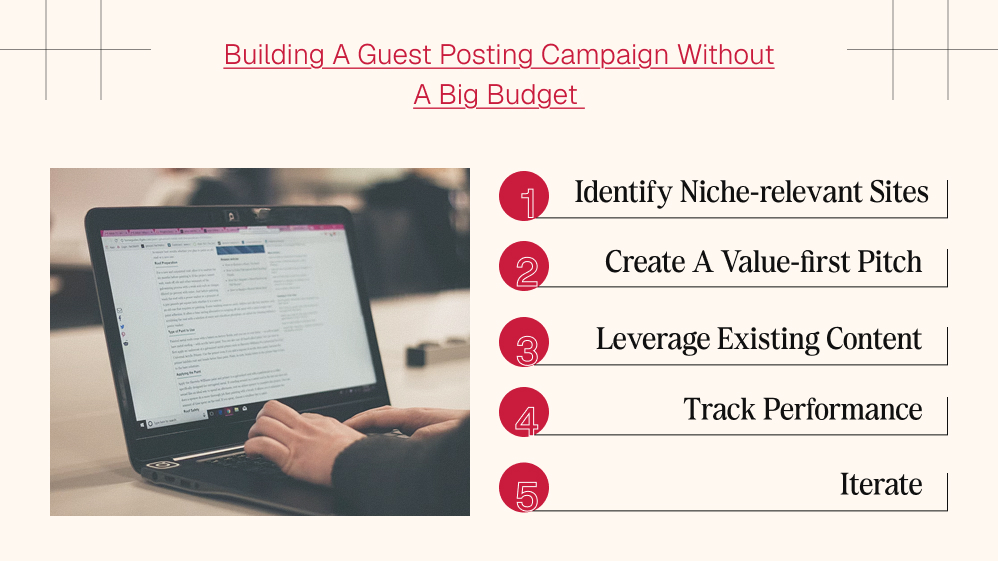
Here is a roadmap that consultants suggested Emily for founder branding:
1. Identify Niche-relevant Sites
Use a simple Google search: “top + [your industry] + blog + guest post.” At the same time, look for domains with a Domain Authority (DA) of 30-50 and an audience that matches your target market.
2. Create A Value-first Pitch
Instead of asking “Can I write for you?”, propose a headline that solves a pain point. For example: “3 Ways SaaS Founders Can Reduce Churn Without Adding Headcount.”
3. Leverage Existing Content
Create a guest post based on a webinar. For example, a large part of this article is based on the webinar that Emily’s consultant held.
It can also be based on a client success story or a similar example. In other words, Google trusts you when you talk about real-world experience. It’s even better if it’s a firsthand experience.
4. Track Performance
Insert a unique UTM parameter on every outbound link. At the same time, record clicks, time on site, and leads in a simple spreadsheet.
5. Iterate
After three posts, compare the guest post price you paid (average $250-$350 per placement in 2024-2026) with the leads generated. Most importantly, adjust the type of sites you target or the topics you pitch.
A Small-scale Success Story: Guest Posting For Lead Generation
| Campaign | Sites Published | Referral Traffic | Leads Generated | Cost |
| Q1 2025 | 4 finance blogs (DA 38 44) | 1,850 visits | 27 demo requests | $1,200 |
| Q2 2025 | 3 startup magazines (DA 45 52) | 2,410 visits | 35 demo requests | $1,050 |
These are the stats of PulseCheck, a health-based startup. The owner and founder, Raj, could not afford a full-time PR specialist.
He allocated $2,250 across six placements, each costing roughly $375 (a typical guest post price for health-tech sites in 2025). Within two months, the referrals accounted for 22% of total website traffic and generated a Guest Posting ROI of 3.5× the spend.
So, what made it work? The blogs highlighted a personal challenge:
“Why I built a wearable after my mother’s stroke.”
The story was authentic, demonstrated experience, and linked back to a landing page offering a free trial. The authenticity satisfied Google’s EEAT guidelines, and the emotional hook turned readers into leads.
How To Check Growth In Online Reputation Through Guest Posting
Honestly, the easiest way to tell if guest posting is doing anything for you is to just keep an eye on where your name starts showing up.
You can use Google Alerts. Whenever you get a brand mention or call out, you will know that your guest posting strategy is working well. What’s best, you will get mentions and queries from sources that you probably did not think of.
But Emily’s consultant said that as a founder, what matters most is how people react to your guest posts. Often, people just reply or become eager to know about your brand. But that’s where many brands make a mistake.
They assume an authoritative tone, trying to establish themselves as experts in the sector. So the smarter thing is not to do that.
One Quick Observation: If you’ve ever tried running ads, you’ll notice they work way better when people are already aware of who you are and what you do.
Guest posts help build that familiarity. Without it, ads feel a bit like shouting into the void. The moment you stop paying, your traffic falls…..
Practical Tips For Founders Who Feel They Lack “Real Business” Credentials
Here, I will disclose the growth tips that the consultant shared on founder branding during a quarterly session in Emily’s office. I watched the video clip of the sessions and found these points the most useful for any founder:
- Show Your Journey: Even a failed side project counts as experience. Write a post titled “What I Learned When My First SaaS Startup Flopped.” Google rewards transparency.
- Cite Reputable Sources: When you reference a 2025 Gartner forecast or a 2026 Statista chart, you add authoritativeness.
- Include Social Proof: A short line like “Featured in TechCrunch and Forbes” under your byline reinforces trust.
- Leverage LinkedIn: Publish a short version of your guest article on LinkedIn. The platform’s algorithm often pushes founder content higher when it’s linked to a reputable external site.
Quick Checklist For A Founder-focused Guest Posting Campaign

• List 10 target blogs/magazines with DA 30-55.
• Draft three pitch emails, each highlighting a specific problem you solved.
• Repurpose one existing case study into a 1,200-word article.
• Add UTM parameters to every backlink.
• Set up a spreadsheet to log guest post price, traffic, leads, and conversion rate.
• Review results after 30 days; aim for a Guest Posting ROI of at least  2 times
Founder Branding Is Easy
You can’t sell your brand by traditional marketing tactics today. Simply put, the competition among funds is immense in the US now.
That’s why you have to do better than simply distributing a corporate brochure among your networks. That’s the quick hack for founder branding that is worth trying now!
What works assuredly in today’s environment is good content. That’s where guest posting also comes in. It is not costly.
At the same time, it is effective for early founders. All you need to do is place your content in front of the right audience.


Must Read

Popular Street Bikes for Everyday Commuting

Head Of Growth Marketing Responsibilities: A Beginner’s Guide To The Role

How To Build A Growth Marketing Strategy That Actually Works

Growth Marketing For Beginners: A Simple Way To Grow Your Small Business

Growth Navigate Startup Tools: The Strategic Tech Stack Framework For Scaling US Companies
Most Popular

A Guide For Deductibles and Premiums in Accident Insurance
Financial Survival Tips for Entrepreneurs in Debt
Toronto Car Insurance vs. Other Cities: Why Are Rates So High?

The Future of MENA Businesses: Why You Need Both Management & Accounting Software


Leave A Reply