


How To Measure Guest Posting ROI Using GSC And Ahrefs?
Over the past two years, my relationship with guest posts has been complex.
At times, I witnessed their potential for nearly two months.
However, after the March 2024 update, things took a turn for the worse. Suddenly, all my blogging sites became content farms.
The result? My site traffic plummeted to a staggering figure of zero.
I realized I needed to adapt my content strategy to turn this situation into an opportunity rather than a setback.
For almost a year, I experimented with various strategies to revive my sites. Surprisingly, my articles weren’t the issue.
The real culprit was the guest posts. Their impact was severe but initially went unnoticed.
They contributed to a slow, poisonous decline, and I didn’t recognize the signs until my sites were practically lifeless.
But here’s the good news! After extensive research and experimentation, I cracked the code.
I created a formula for my guest posts that aligns perfectly with the Google helpful content update.
Now, I can measure guest posting or SEO ROI using tools like GSC and Ahrefs effectively.
I successfully revived one of my sites that had been dormant for almost two years.
And just like that, it now boasts a solid organic traffic of 50k!
What Is SEO ROI All About, And How Can It Help Your Sites?
The return on investment (ROI) for search engine optimization (SEO) quantifies the revenue generated by SEO initiatives in relation to their costs.
This metric is vital for SEO consultants and managers, as well as anyone involved in SEO efforts.
Measuring SEO ROI serves as a critical key performance indicator (KPI) that connects SEO activities to broader business objectives.
A positive SEO ROI indicates that the revenue produced by your SEO strategy exceeds the associated costs.
The formula for calculating SEO ROI is straightforward and parallels the process used for other investment types.
This clarity helps businesses assess the effectiveness of their SEO investments and make informed decisions moving forward.
It looks like this:
SEO ROI (%) = ((Revenue from SEO – SEO Investment) / SEO Investment) × 100
What Are The Steps To Measure SEO ROI Efficiently In 2026?

Measuring the return on investment (ROI) for guest posting campaigns is essential to ensure that these efforts yield tangible results.
Here’s a structured approach to evaluate the success of your guest posting initiatives.
1. Define Your Goals
The first step in measuring ROI is to establish clear goals.
Determine whether your objectives are to drive traffic to your website, generate leads, enhance brand awareness, or optimize for SEO.
Having defined goals will guide you in selecting the appropriate metrics to measure.
2. Measure Referral Traffic
Guest blogging is an effective method for generating referral traffic.
Utilize Google Analytics to monitor the traffic driven by your guest posts across different sites.
To accurately track this traffic, incorporate UTM parameters into the links used in your guest posts.
3. Track Backlink Performance
One of the key benefits of guest blogging is link building.
It’s important to assess both the quantity and quality of backlinks obtained from your guest articles.
Tools like Ahrefs or SEMrush can help you monitor these metrics.
Strong, high authority backlinks are significant for improving your search engine rankings and ensuring long-term visibility.
4. Examine Engagement Metrics
In addition to tracking traffic, it’s important to evaluate how engaged visitors are with your content.
Key engagement metrics to consider include:
- Bounce Rate
- Time on Site
- Pages per Session
- Social Shares and Comments
5. Evaluate Lead Generation and Conversions
If your primary aim is to generate leads, track the number of visitors from guest posts who are signing up for newsletters, downloading resources, or making purchases.
Implementing conversion tracking in Google Analytics will allow you to assess whether your guest posting activities are translating into actual business outcomes.
6. Assess Brand Visibility and Authority
Publishing on high-authority sites can significantly enhance brand recognition.
Keep track of brand mentions, social media discussions, and levels of audience engagement to evaluate how your guest blogging efforts contribute to building brand visibility and authority.
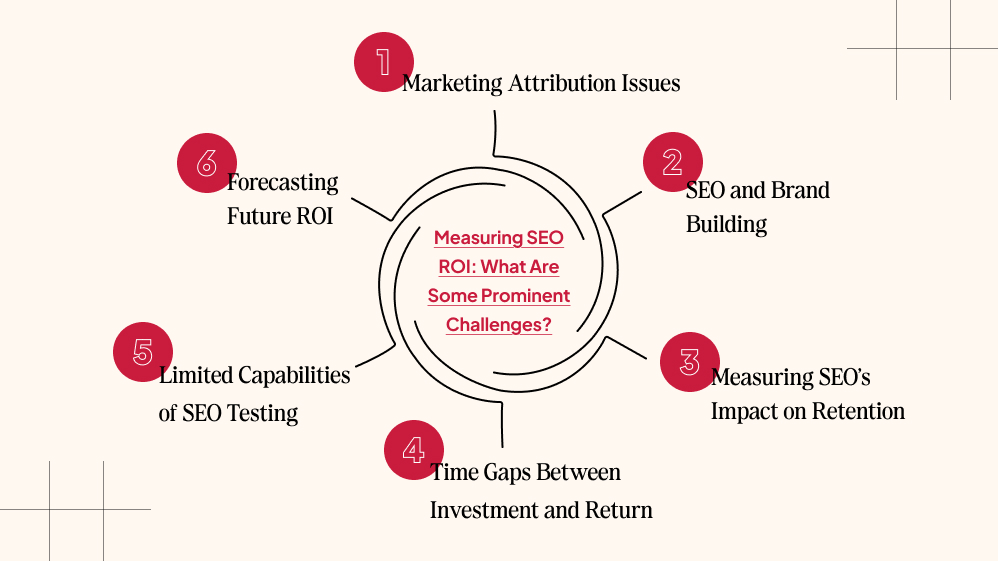
Measuring SEO ROI: What Are Some Prominent Challenges?
Calculating the return on investment (ROI) for SEO can be challenging.
Here are some key issues to consider, along with practical recommendations.
1. Marketing Attribution Issues
Marketing attribution can spark a lot of debate. Some experts believe that trying to measure it properly isn’t worth the effort and that you should trust your instincts instead.
Others think that it’s possible to get it right. The truth is that attributing conversions to marketing channels is always flawed, no matter what model you use.
Simple models, like the last non-direct click, are less reliable than newer methods like data-driven attribution (DDA).
Customer journeys are often more complicated than what analytics tools show.
Since organic search traffic can influence customers at every stage, measuring its impact can be tricky.
While DDA may help improve accuracy for some, it still has limitations. It works best with higher traffic and conversion numbers.
Without hundreds or thousands of conversions each month, you should be cautious with the results.
Plus, you can miss important data when tracking codes are not activated, like with ad blockers or quick exits.
2. SEO and Brand Building
Imagine you watch a YouTube video about a product, search for the brand name, visit their website, and make a purchase.
In this case, organic traffic gets all the credit for the sale. But there are many situations where organic search only appears to matter because of brand searches.
While strong SEO can gain visibility and convert customers throughout the buying process, paid ads may overshadow it due to their prominence.
DDA in GA4 helps address this, but it doesn’t capture the branding benefits of SEO.
Brand awareness created through top-content visibility or outreach is hard to measure effectively.
It’s difficult to analyze the impact of branded versus non-branded organic traffic on conversions.
3. Measuring SEO’s Impact on Retention
Ahrefs serves as a good example of this challenge.
We create content that teaches potential customers about using our tools for SEO and marketing needs.
We don’t use Google Analytics or store cookies, so I can’t provide hard data, but I estimate that 20-30% of organic traffic to our blog comes from current Ahrefs customers. SEO impacts retention in two significant ways:
As customers learn more, they use our tools more frequently, reducing churn rates.
Content about our higher-priced plans encourages some customers to upgrade their subscriptions.
In other words, SEO can enhance customer lifetime value, especially when content supports retention and nurturing efforts.
Yet again, measuring this impact in SEO ROI calculations is tough.
4. Time Gaps Between Investment and Return
When measuring ROI, you need to look at investments and returns over specific time periods.
However, connecting specific investments to returns in SEO is challenging.
The common method of comparing the same monthly periods for investments and returns does not work well here. SEO often takes time to show results.
While “quick wins” can happen, they aren’t guaranteed.
A better approach is to calculate ROI based on categories, pages, or keywords.
You can measure the return from ranking specific pages while keeping track of most of the investments made.
While this approach may exclude broader costs related to technical SEO, these omitted costs usually do not affect the ROI much for a specific page.
You can choose to simplify by leaving them out, as long as you acknowledge their existence.
5. Limited Capabilities of SEO Testing
To understand how well a marketing channel contributes to overall goals, try pausing campaigns and see what happens.
If we want to track conversions, we’d look at how many we still receive when we stop certain marketing activities.
The challenge with SEO is that you can’t simply turn it off.
You could apply a noindex robots meta tag to your entire site, but no reasonable marketer would do that.
Organic search is vital for many businesses, and harming your own SEO can lead to long-term negative effects.
You can still run SEO experiments and tests. There has been significant progress and discussion on SEO testing recently.
However, for measuring effectiveness and return on investment (ROI), it’s nearly impossible for most websites to form a solid hypothesis and valid testing scenarios.
6. Forecasting Future ROI
As SEO professionals, we often get asked about the expected results and ROI from specific SEO activities.
This can be complex, as forecasting SEO is a unique challenge. It can also intersect with the issues mentioned earlier.
Be straightforward about the uncertainties involved. Setting SEO goals and ensuring we meet them is significant. Good communication skills are also essential.
To create specific estimates, consider these factors:
- Past SEO performance of your website and competitors
- Traffic potential of the content you’re focusing on
- Average conversion rate—this can apply mainly to bottom-of-the-funnel content for simplicity.
To examine SEO performance, check your site in Ahrefs’ Site Explorer.
Look at the Performance chart in the Overview report and include your competitors.
This will help you see the link between content output and organic traffic in your field.
It won’t include all link-building and technical SEO aspects, but that makes it more complicated.
For traffic potential, input your target keywords for the new content into Ahrefs’ Keywords Explorer and review the Traffic Potential (TP) column.
Read Also: How Backlinks From Guest Posts Improve Domain Authority?
Measuring SEO ROI: Best Practices That Can Increase Efficiency

Now that I have listed all the steps as well as the potential challenges involved, it’s time I give you some of my special tips.
As they say, loss teaches you more than any win.
The journey of reviving my sites taught me a lot, and these tips are some of the most precious ones that I have learned.
Therefore, as I have successfully revived my sites, I have also learnt all about how to use guest posting for SEO to my advantage.
So, let me share some of the best practices you can implement to ensure a more efficient measurement.
1. Point Out The Traffic That Is Organic And Not Branded
Exclude branded search queries, like your company name, when measuring new demand creation.
Focus on non-branded keywords to find out how many new customers are discovering your business solutions.
2. Implement Reliable Conversion Tracking
Make sure platforms like Google Analytics 4 outline the customer journey.
Differentiate between last-touch conversions and assisted conversions so SEO gets the right credit for helping buyers during their research.
3. Prioritize Content Freshness and Optimization
Updating existing, low-performing content gives a quicker return on investment than creating new posts from scratch.
Focus on high-intent, long-tail keywords that show strong buying intent.
4. Address Technical SEO First
Before increasing content budgets, ensure your site has a solid technical foundation.
Fast page load speeds and good Core Web Vitals reduce bounce rates and improve visitor engagement, guiding users more effectively through conversion funnels.
5. Adopt Automation and AI
Use AI tools for keyword research and content ideas to save on administrative and research time.
Still, keep human oversight to make sure your final output is authentic and valuable.
Measuring SEO ROI Efficiently Is A Prominent Factor To Make Guest Posts Work For You
In conclusion, guest posting has proven to be an essential tactic for businesses and online marketers aiming to expand their reach.
Additionally, as I have shared, I have also used these tactics to enhance SEO and drive targeted traffic.
However, I must also add that it is equally important that you evaluate the return on investment (ROI) from these campaigns.
This way, you will be able to ensure that the efforts yield tangible results.
By implementing the appropriate metrics, you can effectively assess the success of your guest posting initiatives and make informed decisions for future strategies.


Must Read

Is Bankruptcy Right for You? Questions to Ask Before Filing in Georgia

How to Build a Modern Business Protection Strategy

Popular Street Bikes for Everyday Commuting

Head Of Growth Marketing Responsibilities: A Beginner’s Guide To The Role

How To Build A Growth Marketing Strategy That Actually Works
Most Popular

A Guide For Deductibles and Premiums in Accident Insurance
Financial Survival Tips for Entrepreneurs in Debt
Toronto Car Insurance vs. Other Cities: Why Are Rates So High?

The Future of MENA Businesses: Why You Need Both Management & Accounting Software


Leave A Reply