


What A Container Journey Says About Supply Chains?
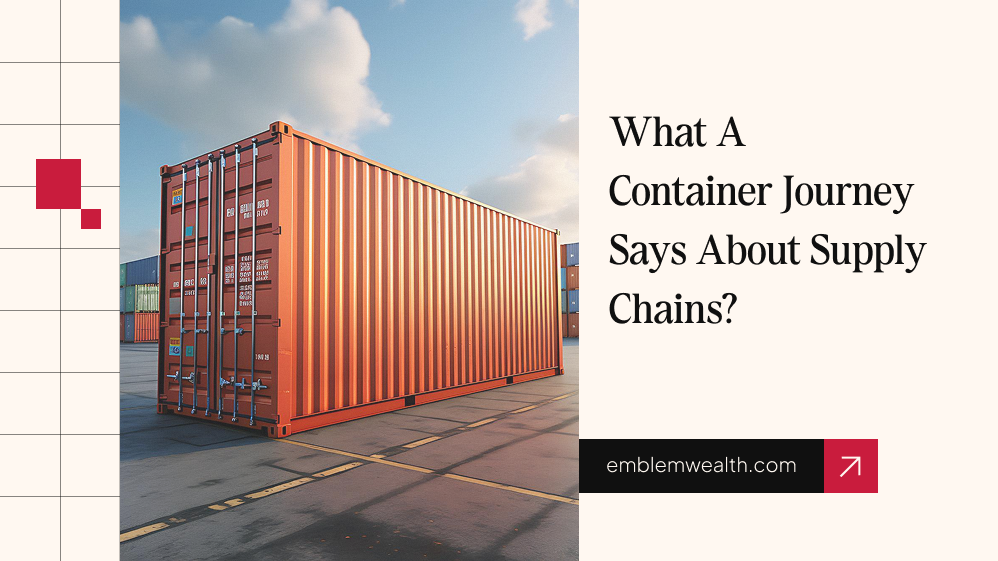
Picture a single metal box. It leaves a factory in one country and lands on a store shelf in another. Nobody thinks twice about it. But that box is quietly running a masterclass in money management.
A shipping container is not just steel and cargo. It’s a small, moving business. It has fixed costs and surprise costs.
Moreover, it has deadlines that cost money if missed. It has to survive weather, paperwork, and price swings it never sees coming.
Sound familiar? It should. That’s also a description of running a startup, or even managing a household budget.
This article breaks down:
- What a shipping container’s journey actually costs
- Why the price swings so wildly, and what founders and
- Everyday savers can steal from that playbook
Why a Shipping Container Is a Better Money Teacher Than a Textbook
Most finance advice is abstract. “Build an emergency fund.” “Diversify your risk.” Fine advice, but hard to picture.
A shipping container makes it concrete, because every stage of its trip has a real, dated, dollar cost attached to it.
Here’s the route in plain terms:
- A factory packs goods into the container.
- A truck or train hauls it to a port.
- The container waits, sometimes for days, before it’s loaded onto a ship.
- It crosses the ocean.
- It clears customs at the destination port.
- A truck moves it to a warehouse or store.
Above, I have described six crucial steps. Every single one can add cost, and every single one can also go wrong.
That’s the whole lesson in one sentence: cost and risk live in the gaps between steps, not just in the big obvious ones.
The Real Cost Of A Shipping Container (And Why It Keeps Changing)
Let’s talk numbers, because vague warnings about “rising costs” don’t help anyone plan a budget.
As of mid-2026, the global average cost to move a standard 40-foot shipping container sits somewhere between $2,300 and $4,600.
Again, that’s depending on the route and the week, according to freight-tracking indexes like Drewry’s World Container Index. In other words, the same shipping container, on a similar route, can cost nearly double depending on timing.
On a full-load booking, a 20-foot shipping container currently starts around $1,200. Meanwhile, a 40-foot shipping container starts around $2,000, before extra charges like fuel surcharges, port handling fees, and paperwork costs are added in.
During calm periods, prices sit near the lower end. During disruptions, like a blocked canal, a spike in demand before a holiday season, or a shortage of empty containers, the same shipping container route can jump toward $9,500 within weeks.
Here’s why that swing matters for anyone running a business, not just shipping companies:
| What drives the cost? | What does it mean for your budget? |
| Season (peak vs. quiet months) | Booking in off-peak windows can cut costs by 10–25% |
| Route and destination | A shipping container to a busy hub costs less per unit than an obscure one |
| Fuel and surcharges | These are added after the base quote. So you need to budget extra room |
| Sudden disruption (weather, conflict, congestion) | Rates can double in weeks with no warning |
This is exactly why a startup that budgets for shipping using only last month’s quote is taking a bigger gamble than it realizes.
Ports Tell the Same Story, Just From the Other Side
Now let us see how things are from the port’s point of view too. Jawaharlal Nehru Port, near Mumbai, handled a record 7.94 million shipping containers (measured in TEUs, or twenty-foot equivalent units) in 2025. That marks a jump of nearly 13% over the year before.
Mundra Port, further up India’s western coast, moved over 7.4 million TEUs in the same stretch, with its busiest single month topping 142,000 containers.
Meanwhile, Jebel Ali Port in Dubai has posted record months of over 1.4 million TEUs, driven largely by cargo flowing in from major Asian trading partners.
None of these numbers matter just as trivia. They matter because volume drives price. When a port is busier than usual, a shipping container can sit longer waiting for a berth, which adds storage fees.
When a port has room to spare, the same shipping container clears faster and cheaper. Busy season at a port behaves a lot like busy season at a bank. In other words, there is more demand, longer queues, along with higher fees for skipping the line.
Three Cost Lessons Every Startup Founder Can Take From a Shipping Container
Think of your operating cash flow the exact same way a freight manager views a container route: a long chain of quiet, unglamorous add-ons that push your actual bill way past the baseline quote.
- The quoted price is never the final price.
Base freight rates rarely account for port handling, customs clearance, or sudden fuel spikes. Founders fall into this exact trap with supplier estimates. Instead of asking what a proposal covers, force the conversation toward what it leaves out.
- Timing beats haggling.
Securing container space during an off-peak lull can slice 10 to 25 percent off your freight costs without any back-and-forth negotiation. Capital works identical to this. Refinancing loans, securing credit, or locking in major inventory orders during quiet market windows will always beat rushing to do it under pressure.
- Idle time costs money.
A container parked at a crowded terminal immediately starts accruing daily storage fees. Capital trapped in overdue invoices or stagnant warehouse stock drains your business the exact same way. It looks harmless for a few days until the holding costs hit your ledger.
Three Risk Lessons for Anyone Managing a Personal or Business Budget
A shipping container’s journey is also a live lesson in why “plan for the average” isn’t a real plan.
- Averages hide the disaster case.
The average shipping container cost might sound stable. But the range around that average, which is sometimes triple the low end, is where real damage happens. A personal or business budget built only around the “usual” month will break the first time an unusual month shows up.
- One chokepoint can freeze the whole system.
A single blocked canal or congested port can delay thousands of shipping container movements at once. A single missed invoice, late client payment, or unexpected repair bill can do the same thing to a small business’s cash flow.
- Buffers are cheaper than emergencies.
Shippers who build in extra time and a wider cost range rarely panic when rates spike. Savers and founders who keep a cash buffer face the same kind of disruption with far less stress.
Three Cash-Flow Timing Lessons Hidden in the Shipping Route
- Money moves in stages, not all at once.
A shipping container’s cost is paid in pieces. For instance, the booking fee, fuel surcharge, port fee, and customs fee are spread across weeks. Business expenses often work the same way. Meanwhile, founders who budget for a single lump sum get caught off guard by the pieces.
- Delays are a cost, even without a dollar sign.
A shipping container stuck in customs isn’t charging extra every hour. But it’s blocking revenue from that inventory. Late-arriving payments or slow project approvals do the same invisible damage to a budget.
- Predictability has a price, and it’s usually worth paying.
Locking in a fixed-rate shipping contract costs a bit more than gambling on the spot market. But it removes the guesswork. The same logic applies to fixed-rate loans versus variable ones for a growing business.
A Quick Glossary To Decode Container Supply Chain Jargons
| Term | What It Actually Means |
| TEU | Twenty-foot Equivalent Unit: the standard way to count shipping container capacity |
| FCL | Full Container Load: you rent the whole shipping container, even if it’s not full |
| LCL | Less than Container Load: you share a shipping container with other shippers and pay only for your share |
| Freight rate | The base price to move a shipping container, before extra fees |
| Surcharge | An added fee on top of the base rate, often for fuel or peak-season demand |
| Demurrage | A fee charged when a shipping container sits at a port longer than the free allowed time |
A Simple Example to Tie It Together
Say a small business owner plans to import furniture using one 40-foot shipping container. The quote comes in at $2,400. Feeling good about the price, they book it and move on.
Three weeks later, the invoice arrives with an extra $600 in fuel surcharges, $150 in port handling fees, and a $200 documentation charge.
The real cost wasn’t $2,400. It was $3,350, which is nearly 40% more than the number they budgeted around.
This is not a rare story. It’s the default story, because shipping container quotes are built to show the smallest number first.
The founders who protect their cash flow are the ones who ask, “What’s not included in this price?” before they sign anything. It’s a habit that applies just as well to loan offers, subscription pricing, and vendor contracts.
The Takeaway
A shipping container doesn’t look like a financial tool. It’s a metal box. But its journey is a working model of how money actually moves through a business or a household.
You need to take care of parameters like hidden fees, timing swings, chokepoints, and the buffer built in by smart shippers. That’s the only lesson you need to make your business supply chain more stable and effective.
Explore how each stage connects in real time by viewing the accompanying visual resource from CS Recruiting, a logistics and supply chain recruitment agency.



Must Read

Is Bankruptcy Right for You? Questions to Ask Before Filing in Georgia

How to Build a Modern Business Protection Strategy

Popular Street Bikes for Everyday Commuting

Head Of Growth Marketing Responsibilities: A Beginner’s Guide To The Role

How To Build A Growth Marketing Strategy That Actually Works
Most Popular

A Guide For Deductibles and Premiums in Accident Insurance
Financial Survival Tips for Entrepreneurs in Debt
Toronto Car Insurance vs. Other Cities: Why Are Rates So High?

The Future of MENA Businesses: Why You Need Both Management & Accounting Software



Leave A Reply